Introduction to Industrial Instrumentation – Complete Guide for Beginners
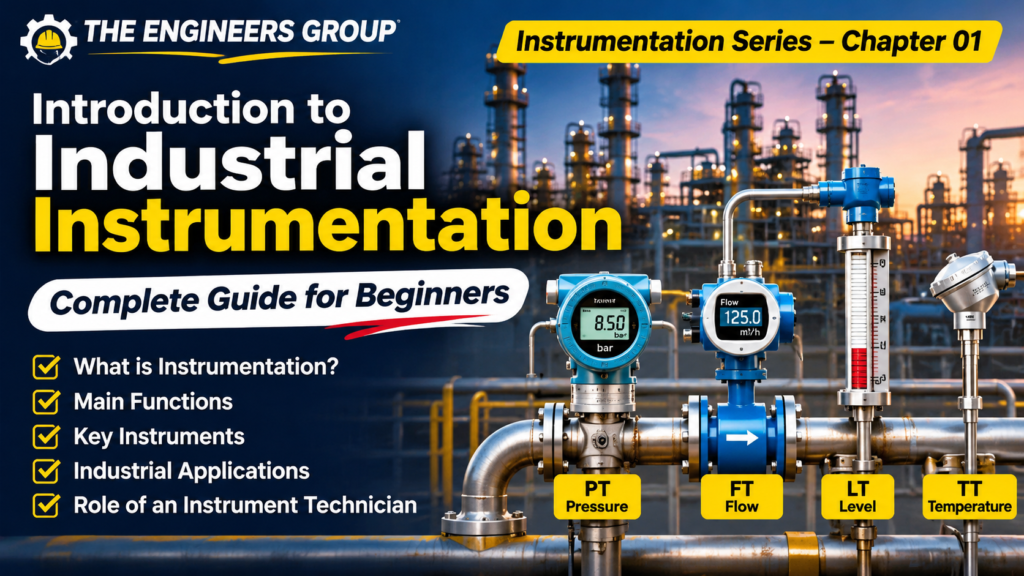
Introduction to Industrial Instrumentation
Complete Guide for Beginners
1. What Is Industrial Instrumentation?
Industrial Instrumentation is a branch of engineering that deals with the measurement, monitoring, indication, transmission and control of industrial process variables.
It plays an important role in modern industries such as power plants, oil and gas facilities, chemical plants, cement factories, pharmaceutical industries, water treatment plants and manufacturing facilities.
Industrial processes involve several parameters that must be measured and controlled to ensure safe, reliable and efficient plant operation.
The major process variables include:
- Pressure
- Temperature
- Flow
- Level
- pH
- Conductivity
- Speed
- Position
For example, in a boiler system, pressure transmitters monitor steam pressure, temperature sensors measure steam temperature and level transmitters monitor the water level inside the boiler drum.
The measured information is transmitted to control systems such as PLC or DCS, allowing operators to monitor and control the industrial process.
📘 WANT TO LEARN INSTRUMENTATION PRACTICALLY?
Get our 380+ Pages Instrumentation Technician Complete Practical E-book.
BUY E-BOOK NOW2. Why Is Industrial Instrumentation Important?
Industrial instrumentation helps industries maintain accurate process conditions and improve operational efficiency.
Its major benefits include:
- Accurate measurement of process variables.
- Continuous monitoring of industrial equipment.
- Automatic control of industrial processes.
- Improved product quality.
- Reduced operational errors.
- Early detection of abnormal conditions.
- Improved equipment reliability.
- Support for industrial safety and protection systems.
Without proper instrumentation, operators would have difficulty monitoring and controlling complex industrial processes.
3. Main Functions of Industrial Instrumentation
1. Measurement
Measurement is the process of determining the value of a physical variable such as pressure, temperature, flow or level.
2. Indication
Indication means displaying the measured value through pressure gauges, temperature indicators, digital displays or control room screens.
3. Transmission
Transmission involves sending measurement signals from field instruments to control systems.
A commonly used industrial analog signal is 4–20 mA.
4. Control
Control systems maintain process variables near their desired setpoints by operating final control elements.
5. Monitoring and Protection
Instrumentation provides process information, alarms and signals used by plant monitoring and protection systems.
4. Main Process Variables in Instrumentation
Industrial instruments measure different physical and chemical parameters.
| Process Variable | Common Measuring Instruments |
|---|---|
| Pressure | Pressure Gauge, Pressure Transmitter |
| Temperature | RTD, Thermocouple |
| Flow | Orifice Plate, Magnetic Flow Meter |
| Level | DP, Radar, Ultrasonic Transmitter |
| pH | pH Analyzer |
| Conductivity | Conductivity Analyzer |
| Speed | Speed Sensor, Tachometer |
| Position | Position Transmitter, Limit Switch |
5. Main Components of an Instrumentation System
A typical industrial instrumentation system consists of the following components.
1. Sensor
A sensor detects a physical variable and responds to changes in the process condition.
Example: RTD detects temperature.
2. Transmitter
A transmitter converts the sensor measurement into a standard output signal.
Example: A temperature transmitter converts an RTD measurement into a 4–20 mA signal.
3. Controller
A controller receives the measurement signal, compares the process variable with the setpoint and calculates the required control action.
Examples: PLC, DCS and PID Controller.
4. Final Control Element
A final control element changes the process according to the controller output.
Examples: Control Valve, Variable Frequency Drive and Motor Control System.
💬 NEED GUIDANCE IN INSTRUMENTATION?
Contact THE ENGINEERS GROUP for eBook details, course information and learning support.
MESSAGE US ON WHATSAPP6. Basic Working Principle of Industrial Instrumentation
A typical industrial measurement and control system works through the following stages.
Step 1 – Process Variable
A physical variable exists in the industrial process, such as pressure, temperature, flow or level.
Step 2 – Sensor
The sensor detects the physical variable and responds to changes in the process condition.
Step 3 – Transmitter
The transmitter converts the sensor measurement into a standard output signal, commonly 4–20 mA.
Step 4 – Controller
A PLC or DCS receives and processes the measurement signal according to the configured control logic.
Step 5 – Final Control Element
A control valve, motor or other final control element adjusts the process according to the control command.
7. Common Instruments Used in Industries
1. Pressure Transmitter
A pressure transmitter measures pressure in industrial pipelines, tanks, vessels and process equipment.
2. Temperature Sensor
RTDs and thermocouples are commonly used to measure industrial process temperatures.
3. Flow Meter
A flow meter measures the flow rate of liquids, gases or steam.
4. Level Transmitter
A level transmitter measures the level of liquids or solids inside tanks and vessels.
5. Control Valve
A control valve regulates the flow of liquids, gases or steam according to a control signal.
6. Pressure Gauge
A pressure gauge provides local indication of pressure.
7. Level Switch
A level switch detects a specific level condition and provides a switching output.
8. Applications of Industrial Instrumentation
Industrial instrumentation is used in several important applications:
- Process monitoring and control.
- Boiler and steam system monitoring.
- Water treatment and wastewater treatment.
- Chemical process control.
- Pump and compressor monitoring.
- Tank level management.
- Temperature control systems.
- Industrial automation.
- Alarm and trip systems.
- Equipment protection.
9. Industries Using Instrumentation
Instrumentation is widely used in the following industries:
- Thermal and Hydroelectric Power Plants.
- Oil and Gas Industries.
- Chemical and Petrochemical Industries.
- Cement Manufacturing Plants.
- Steel Industries.
- Pharmaceutical Industries.
- Food and Beverage Industries.
- Water Treatment Plants.
- Paper and Pulp Industries.
- Manufacturing Industries.
10. Role and Responsibilities of an Instrument Technician
An Instrument Technician is responsible for installing, maintaining, testing and troubleshooting industrial measurement and control instruments.
Major responsibilities include:
- Installing field instruments.
- Performing instrument calibration.
- Checking transmitter outputs.
- Maintaining pressure, temperature, flow and level instruments.
- Performing loop checking.
- Inspecting control valves and positioners.
- Troubleshooting instrument faults.
- Reading P&ID and loop diagrams.
- Maintaining calibration and maintenance records.
- Following industrial safety procedures.
11. Important Instrumentation Terms
Process Variable (PV):
The actual measured value of a process parameter.
Setpoint (SP):
The desired value that a control system is intended to maintain.
Manipulated Variable (MV):
The variable adjusted by the control system to influence the process.
Controller:
A device or software function that compares the process variable with the setpoint and calculates a control action.
Feedback:
Information returned from the process measurement to the controller.
Transmitter:
An instrument that converts a measured variable into a standard output signal.
Calibration:
The process of comparing an instrument’s indication or output with a known reference standard. Adjustment may be performed when required.
12. Practical Industrial Example – Water Tank Level Control
Consider a water storage tank used in an industrial plant.
Main System Components:
- LT – Level Transmitter
- PLC – Programmable Logic Controller
- CV – Control Valve
- Water Storage Tank
Working Principle:
- The level transmitter continuously measures the water level.
- The measured signal is transmitted to the PLC.
- The PLC compares the measured level with the configured setpoint.
- The PLC sends a control command to the control valve.
- The control valve adjusts water inflow to maintain the desired level.
This is an example of a closed-loop control system.
🎓 WATCH COMPLETE INSTRUMENT TECHNICIAN VIDEO COURSE
Learn Instrumentation through our complete video lecture series on YouTube.
✔ Step-by-Step Video Lectures
✔ Industrial Instrumentation Concepts
✔ Practical Knowledge for Technicians
▶ WATCH COMPLETE VIDEO COURSETHE ENGINEERS GROUP
13. Industrial Safety for Instrument Technicians
Safety is an essential part of instrumentation work.
Every Instrument Technician should understand:
- Personal Protective Equipment (PPE).
- Permit to Work (PTW).
- Lockout and Tagout (LOTO).
- Electrical isolation.
- Pressure isolation and depressurization.
- Hazardous area requirements.
- Safe handling of process connections.
- Approved calibration and maintenance procedures.
Always follow approved site safety procedures before working on any instrument or process equipment.
14. Instrumentation Interview Questions and Answers
Q1. What is Industrial Instrumentation?
Answer: Industrial Instrumentation is the branch of engineering that deals with measuring, monitoring and controlling industrial process variables such as pressure, temperature, flow and level.
Q2. What is the function of a transmitter?
Answer: A transmitter converts a sensor measurement into a standard output signal, such as 4–20 mA, for monitoring and control systems.
Q3. What is a process variable?
Answer: A process variable is the actual measured value of a parameter such as pressure, temperature, flow or level.
Q4. What is a setpoint?
Answer: A setpoint is the desired value that a control system is intended to maintain.
Q5. What is the difference between a sensor and a transmitter?
Answer: A sensor detects a physical variable, while a transmitter converts the measurement into a standard output signal.
Q6. What is PLC?
Answer: PLC stands for Programmable Logic Controller. It is an industrial digital controller used for automation and process control.
Q7. What is DCS?
Answer: DCS stands for Distributed Control System. It is an industrial control system used to monitor and control complex processes through distributed controllers.
Q8. What is a control valve?
Answer: A control valve is a final control element used to regulate the flow of fluids according to a control signal.
Q9. What is calibration?
Answer: Calibration is the comparison of an instrument’s indication or output against a known reference standard to determine its measurement performance.
Q10. What is loop checking?
Answer: Loop checking is the process of verifying the complete signal path between a field instrument and the control system, including wiring, signal transmission, indication and control response as applicable.
15. Multiple Choice Questions (MCQs)
Q1. What is the main purpose of industrial instrumentation?
A. To increase equipment size
B. To measure, monitor and control process variables
C. To reduce the number of operators
D. To replace mechanical equipment
Correct Answer: B
Q2. Which instrument is used to measure pressure?
A. RTD
B. Flow Meter
C. Pressure Transmitter
D. Thermocouple
Correct Answer: C
Q3. Which sensor is commonly used for temperature measurement?
A. RTD
B. Pressure Gauge
C. Orifice Plate
D. Level Switch
Correct Answer: A
Q4. What is the function of a transmitter?
A. To increase pipeline pressure
B. To convert measurement into a standard signal
C. To operate a pump mechanically
D. To store process liquid
Correct Answer: B
Q5. Which system is commonly used for industrial process control?
A. Printer
B. PLC
C. Keyboard
D. Monitor
Correct Answer: B
Q6. What does PV stand for in process control?
A. Pressure Value
B. Process Voltage
C. Process Variable
D. Power Variation
Correct Answer: C
Q7. Which device regulates process flow?
A. Control Valve
B. Pressure Gauge
C. RTD
D. Thermocouple
Correct Answer: A
Q8. What does SP represent in a control loop?
A. Signal Pressure
B. Setpoint
C. Supply Power
D. Sensor Position
Correct Answer: B
Q9. Which instrument measures liquid flow?
A. Flow Meter
B. Temperature Sensor
C. Pressure Gauge
D. Level Switch
Correct Answer: A
Q10. What is the main responsibility of an Instrument Technician?
A. Civil Construction
B. Instrument installation, calibration, maintenance and troubleshooting
C. Accounting
D. Material Transportation
Correct Answer: B
16. Chapter Summary
Industrial Instrumentation is an essential part of modern process industries. It enables accurate measurement, monitoring, transmission and control of industrial process variables.
Understanding sensors, transmitters, controllers and final control elements provides the foundation for learning advanced instrumentation topics.
Instrument Technicians must develop knowledge of measurement principles, calibration, installation, maintenance, troubleshooting and industrial safety.
What You Will Learn in the Next Chapter
Chapter 02 – Measurement Fundamentals
In the next chapter, we will learn:
- Fundamentals of Measurement.
- Direct and Indirect Measurement.
- Measurement Units.
- SI Units and Standards.
- Primary and Secondary Instruments.
- Measurement Systems.
- Industrial Measurement Examples.
THE ENGINEERS GROUP
Free Engineering Education for Everyone.
Learn. Practice. Improve. Grow.
Connect With THE ENGINEERS GROUP
Stay connected with THE ENGINEERS GROUP for industrial engineering tutorials, practical knowledge, interview preparation and free technical study materials.
CONNECT WITH THE ENGINEERS GROUP
Learn. Practice. Improve. Grow.
📘 BUY INSTRUMENT TECHNICIAN E-BOOK 💬 MESSAGE US ON WHATSAPP ▶ FREE COURSE ON YOUTUBE WATCH VIDEO ON FACEBOOKTHE ENGINEERS GROUP
Free Engineering Education for Everyone