PLC Programming Course – Chapter 02: Industrial Automation Fundamentals and Applications
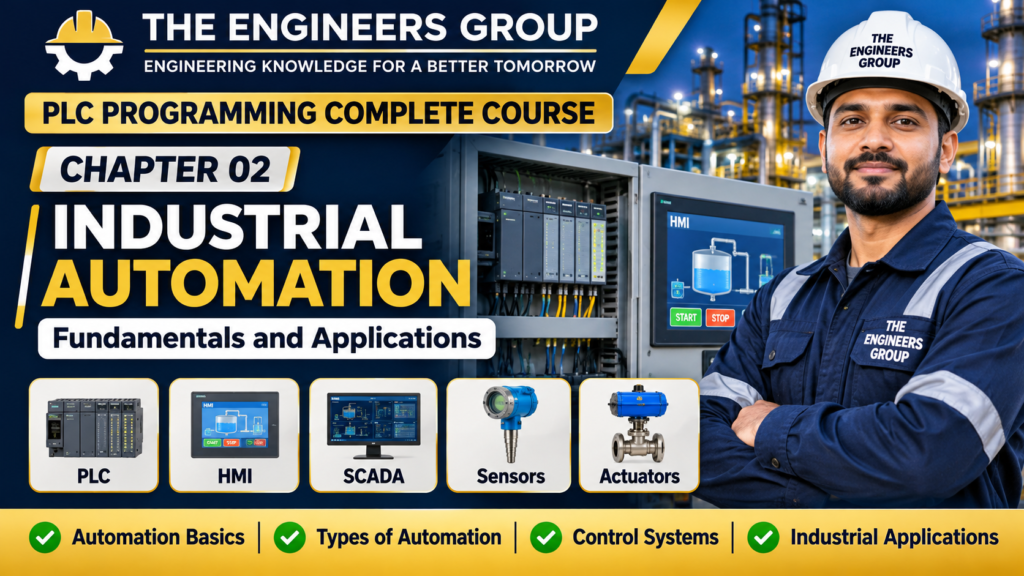
PLC Programming Course – Chapter 02
Table of Contents
- Introduction to Industrial Automation
- What is Industrial Automation?
- History and Evolution of Industrial Automation
- Levels of Industrial Automation
- Types of Industrial Automation
- Fixed Automation
- Programmable Automation
- Flexible Automation
- Basic Elements of an Automation System
- Sensors and Transducers
- Controllers
- Actuators
- Human Machine Interface (HMI)
- SCADA System
- Communication Systems
- Role of PLC in Industrial Automation
- Open Loop and Closed Loop Control Systems
- Difference Between Automation and Manual Control
- Industrial Automation Applications
- Advantages of Industrial Automation
- Challenges of Industrial Automation
- Practical Industrial Example – Automated Tank Level Control
- Important Industrial Automation Terminology
- Industrial Automation Interview Questions and Answers
- Multiple Choice Questions (MCQs)
- Chapter Summary
1. Introduction to Industrial Automation
Industrial Automation Course is designed to explain how modern industries use automation systems to improve productivity, accuracy, safety, and operational efficiency. Industrial automation combines PLCs, sensors, actuators, HMI, SCADA, and industrial communication networks to monitor and control industrial processes with minimum manual intervention.
In traditional industries, many operations were performed manually by operators. Machines were controlled using manual switches, push buttons, mechanical devices, and relay-based control systems.
However, modern industries require higher production efficiency, better accuracy, improved safety, and continuous monitoring. Industrial automation makes these requirements possible through advanced control systems and automated equipment.
Today, industrial automation uses different technologies such as:
- Programmable Logic Controllers (PLC)
- Distributed Control Systems (DCS)
- Supervisory Control and Data Acquisition (SCADA)
- Human Machine Interface (HMI)
- Sensors and Transmitters
- Industrial Robots
- Variable Frequency Drives (VFD)
- Industrial Communication Networks
These technologies work together to control and monitor industrial operations.
2. What is Industrial Automation?
Industrial automation is the use of control systems, computers, sensors, actuators, and communication technologies to operate industrial machines and processes with minimum human intervention.
It allows machines and equipment to perform repetitive operations automatically according to predefined control logic.
Simple Definition
Industrial automation is the process of using technology and control systems to operate industrial machines and manufacturing processes automatically.
Example of Industrial Automation
Consider an automatic water filling machine.
- Empty bottles arrive on a conveyor.
- A sensor detects the presence of a bottle.
- The PLC receives the sensor signal.
- The PLC activates the filling valve.
- Water enters the bottle for a predefined time or until the required level is detected.
- The valve closes automatically.
- The conveyor moves the filled bottle to the next station.
All these operations are performed automatically using sensors, PLC programming, actuators, and control equipment.
3. History and Evolution of Industrial Automation
Industrial automation has developed significantly over time.
3.1 Manual Operation
In early industries, machines were operated manually by workers. Operators controlled machines using mechanical switches, levers, and manual valves.
3.2 Mechanical Automation
Mechanical systems introduced devices such as gears, cams, shafts, and mechanical linkages to automate repetitive operations.
3.3 Electrical and Relay-Based Automation
Electrical control systems introduced motors, contactors, relays, timers, and switches.
Relay-based control panels became common in industrial machine automation.
3.4 PLC-Based Automation
Programmable Logic Controllers introduced flexible programmable control systems.
Instead of changing complex electrical wiring, engineers could modify machine operations by changing the PLC program.
3.5 Computer-Based Automation
Industrial computers, SCADA systems, DCS, and advanced communication networks improved monitoring and process control.
3.6 Smart Automation and Industry 4.0
Modern industrial automation uses technologies such as:
- Industrial Internet of Things (IIoT)
- Artificial Intelligence (AI)
- Machine Learning
- Cloud Computing
- Robotics
- Predictive Maintenance
- Digital Twins
These technologies help industries improve operational efficiency, monitoring, and decision-making.
💬 NEED GUIDANCE IN PLC?
Contact THE ENGINEERS GROUP for eBook details, course information and learning support.
MESSAGE US ON WHATSAPP4. Levels of Industrial Automation
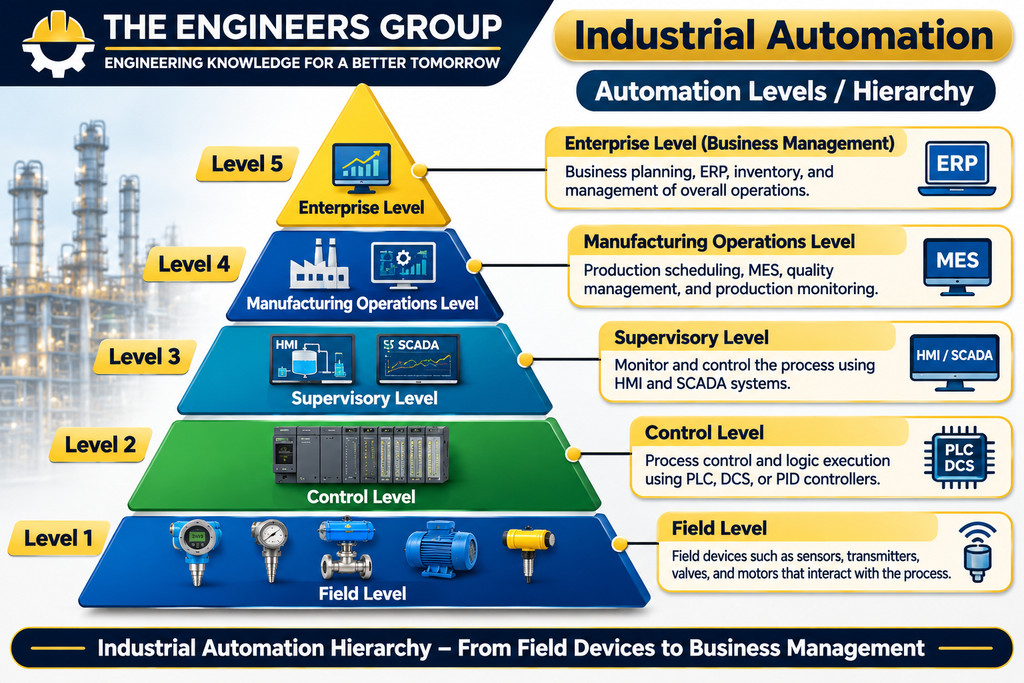
Industrial automation systems are commonly organized into different levels based on their functions.
Level 1: Field Level
The field level contains devices that directly interact with industrial processes.
Examples:
- Pressure Transmitters
- Temperature Sensors
- Flow Meters
- Level Transmitters
- Proximity Sensors
- Control Valves
- Motors
These devices measure process parameters or perform physical actions.
Level 2: Control Level
The control level processes field signals and executes control operations.
Examples:
- PLC
- DCS Controllers
- PID Controllers
- Motor Control Systems
The controller receives input signals, processes control logic, and generates output commands.
Level 3: Supervisory Level
The supervisory level allows operators and engineers to monitor and control industrial processes.
Examples:
- HMI
- SCADA
- Operator Stations
- Engineering Workstations
Operators can monitor equipment status, process values, alarms, and trends.
Level 4: Manufacturing Operations Level
This level manages production operations and manufacturing activities.
Examples:
- Production Scheduling
- Manufacturing Execution Systems (MES)
- Production Monitoring
- Quality Management
Level 5: Enterprise Level
The enterprise level manages business-related activities across the organization.
Examples:
- Enterprise Resource Planning (ERP)
- Business Planning
- Inventory Management
- Production Planning
- Business Analytics
These levels represent a simplified industrial automation hierarchy. Actual architectures may combine or distribute functions differently.
5. Types of Industrial Automation
Industrial automation can be classified into three major types based on production requirements.
5.1 Fixed Automation
Fixed automation is designed to perform a specific operation repeatedly using dedicated equipment.
The production sequence is generally fixed and difficult to modify.
Characteristics:
- High production volume.
- Repetitive operations.
- Dedicated machinery.
- Limited flexibility.
- High initial investment.
Applications:
- Automobile assembly lines.
- Bottling plants.
- Packaging machines.
- High-speed production lines.
5.2 Programmable Automation
Programmable automation uses programmable control systems to perform different operations by changing the control program.
Characteristics:
- Suitable for batch production.
- Programs can be modified.
- More flexible than fixed automation.
- Requires programming and configuration.
Applications:
- CNC Machines.
- PLC-Controlled Production Systems.
- Batch Processing Plants.
- Automated Machine Tools.
5.3 Flexible Automation
Flexible automation allows production equipment to perform different operations with minimal changeover time.
Characteristics:
- High flexibility.
- Automated product changeover.
- Computer-controlled production.
- Suitable for varying product requirements.
Applications:
- Robotic Manufacturing.
- Flexible Manufacturing Systems.
- Automotive Production.
- Automated Assembly Systems.
Comparison of Automation Types
| Parameter | Fixed | Programmable | Flexible |
|---|---|---|---|
| Flexibility | Low | Medium | High |
| Production | High volume | Batch production | Mixed production |
| Changeover | Difficult | Program-based | Quick |
| Initial Cost | High | Variable | Generally high |
| Applications | Assembly lines | CNC machines | Robotic systems |
6. Basic Elements of an Automation System
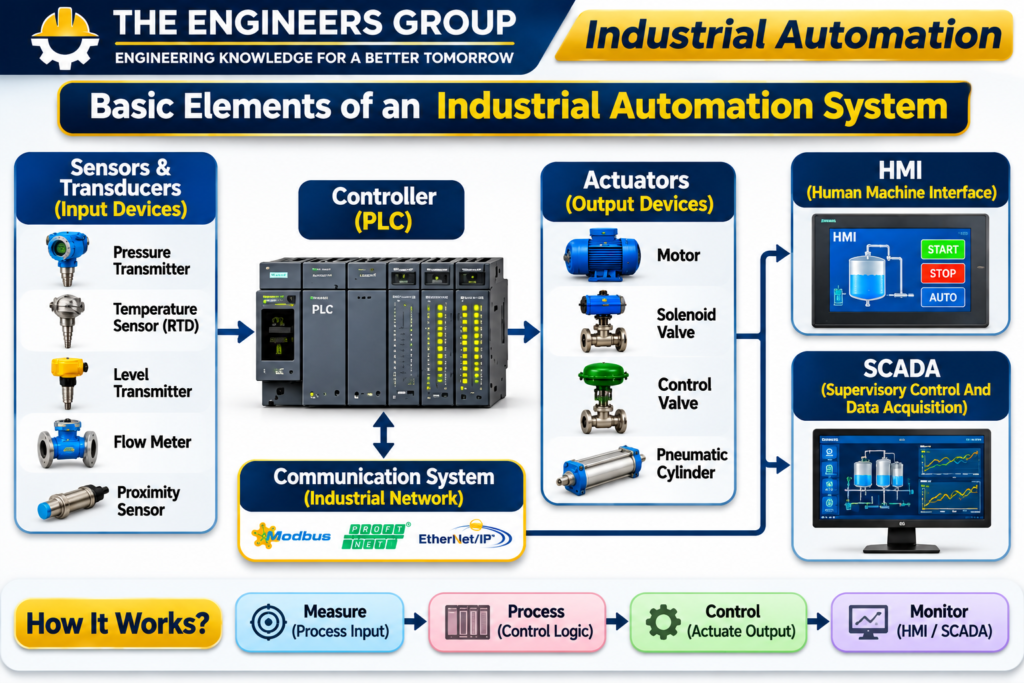
An industrial automation system consists of several important components that work together.
6.1 Sensors and Transducers
Sensors detect physical conditions and convert them into signals that can be used by control systems.
Common industrial sensors include:
- Temperature Sensors
- Pressure Sensors
- Level Sensors
- Flow Sensors
- Proximity Sensors
- Photoelectric Sensors
- Position Sensors
A transducer converts one form of energy or physical quantity into another form of signal.
For example, a temperature sensor measures temperature and provides a corresponding electrical signal through its sensing element or transmitter arrangement.
6.2 Controllers
Controllers process input signals and generate output commands according to programmed logic or control algorithms.
Common industrial controllers include:
- PLC
- DCS Controller
- PID Controller
- Industrial Computer
The PLC is one of the most widely used controllers in industrial machine automation.
6.3 Actuators
Actuators convert control signals into physical actions.
Common examples include:
- Electric Motors
- Pneumatic Cylinders
- Hydraulic Cylinders
- Solenoid Valves
- Electric Control Valve Actuators
- Servo Motors
For example, a PLC can activate a solenoid valve to control the movement of a pneumatic cylinder.
6.4 Human Machine Interface (HMI)
HMI stands for Human Machine Interface.
It provides an interface between the operator and the industrial automation system.
Using an HMI, operators can:
- Start and Stop Machines.
- Monitor Process Values.
- View Equipment Status.
- Acknowledge Alarms.
- Change Authorized Setpoints.
- Monitor Production Information.
6.5 SCADA System
SCADA stands for Supervisory Control and Data Acquisition.
It is a supervisory system used to monitor and control industrial processes from centralized or distributed operator stations.
Main functions of SCADA:
- Real-Time Monitoring.
- Data Acquisition.
- Alarm Management.
- Historical Data Storage.
- Trend Monitoring.
- Supervisory Control.
SCADA systems are commonly used in power plants, water treatment plants, oil and gas facilities, and large industrial installations.
6.6 Communication Systems
Communication systems allow industrial devices to exchange data.
Common industrial communication protocols include:
- Modbus RTU
- Modbus TCP
- PROFINET
- PROFIBUS
- EtherNet/IP
- CANopen
- OPC UA
The selected protocol depends on equipment compatibility, application requirements, and network architecture.
7. Role of PLC in Industrial Automation
PLC plays an important role in modern industrial automation.
It receives signals from sensors and switches, executes the control program, and operates output devices.
Main Functions of PLC
- Reading Digital Inputs.
- Reading Analog Inputs.
- Executing Ladder Logic.
- Performing Timer Operations.
- Performing Counter Operations.
- Controlling Motors and Valves.
- Processing Analog Signals.
- Communicating with HMI and SCADA.
- Monitoring Machine Conditions.
- Performing Industrial Control Operations.
Example
In an automatic conveyor system:
- A proximity sensor detects the product.
- The PLC receives the sensor signal.
- The PLC checks the programmed conditions.
- The PLC activates the motor contactor or drive command.
- The conveyor moves the product to the next station.
This operation is controlled automatically through PLC programming.
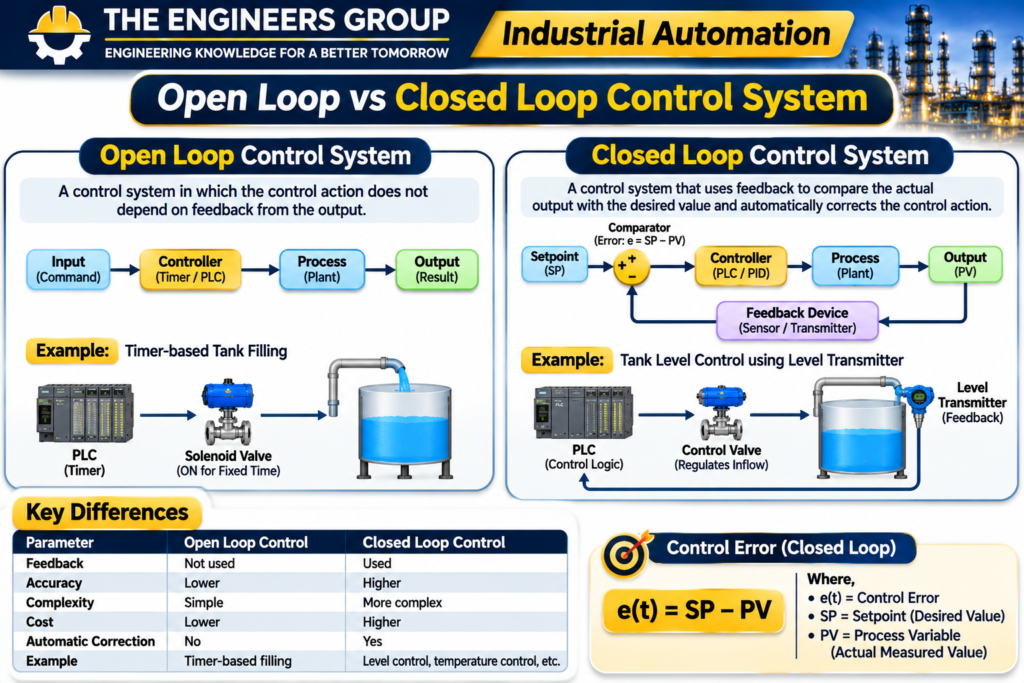
8. Open Loop and Closed Loop Control Systems
Control systems are generally classified into two major types.
8.1 Open Loop Control System
An open loop control system performs an operation without using feedback from the output to correct the control action.
The controller does not automatically compare the actual output with the desired output.
Example:
A simple timer-based water filling system that opens a valve for a fixed time without measuring the actual water level.
Characteristics:
- No output feedback.
- Simple control structure.
- Generally lower cost.
- Less accurate when process conditions change.
8.2 Closed Loop Control System
A closed loop control system uses feedback to compare the actual process value with the desired setpoint.
The controller adjusts its output according to the error.
Example:
An automatic tank level control system using a level transmitter and a control valve.
The controller continuously monitors the tank level and adjusts the valve position to maintain the desired level.
Closed Loop Control Formula
The control error is:
e(t) = SP – PV
Where:
- e(t) = Control Error
- SP = Setpoint
- PV = Process Variable
Comparison Between Open Loop and Closed Loop
| Parameter | Open Loop | Closed Loop |
|---|---|---|
| Feedback | Not used | Used |
| Accuracy | Generally lower | Generally higher |
| Complexity | Simple | More complex |
| Cost | Usually lower | Usually higher |
| Automatic Correction | No feedback correction | Feedback correction |
| Example | Timer-based filling | Level transmitter-based filling |
9. Difference Between Automation and Manual Control
| Parameter | Manual Control | Automatic Control |
|---|---|---|
| Operation | Operator controlled | System controlled |
| Human Intervention | High | Reduced |
| Speed | Depends on operator | Consistent system response |
| Accuracy | Depends on operator and equipment | Depends on system design |
| Monitoring | Manual observation | Sensors and monitoring systems |
| Repetitive Tasks | Operator performs tasks | System performs programmed tasks |
| Applications | Manual machines | Automated production lines |
10. Industrial Automation Applications
Industrial automation is used in different industries.
10.1 Manufacturing Industry
Used for automated assembly lines, robotic machines, material handling, and production monitoring.
10.2 Power Plants
Used for auxiliary equipment control, pump operation, monitoring, and process automation.
10.3 Oil and Gas Industry
Used for pipeline monitoring, pump control, process monitoring, and industrial equipment automation.
10.4 Water Treatment Plants
Used for pump control, tank level monitoring, filtration systems, and chemical dosing operations.
10.5 Cement Industry
Used for conveyor systems, crushers, feeders, kiln monitoring, and material handling.
10.6 Pharmaceutical Industry
Used for automated batching, temperature monitoring, production control, and process data monitoring.
10.7 Food and Beverage Industry
Used for filling, packaging, mixing, sorting, and conveyor automation.
10.8 Automotive Industry
Used for robotic welding, assembly lines, painting systems, and automated inspection.
11. Advantages of Industrial Automation
Industrial automation provides several benefits.
- Increased Production Efficiency.
- Improved Product Quality.
- Reduced Manual Intervention.
- Consistent Production Operations.
- Better Process Monitoring.
- Improved Equipment Control.
- Reduced Repetitive Manual Work.
- Better Production Data Collection.
- Improved Operational Safety when properly designed.
- Increased Production Flexibility.
12. Challenges of Industrial Automation
Although industrial automation provides many benefits, it also introduces certain challenges.
12.1 High Initial Investment
Industrial automation equipment, controllers, sensors, and software can require significant initial investment.
12.2 Skilled Manpower Requirement
Automation systems require trained engineers and technicians for installation, programming, commissioning, and maintenance.
12.3 Maintenance Complexity
Advanced automation systems may require specialized troubleshooting tools and technical knowledge.
12.4 Cybersecurity Risks
Connected industrial systems may face cybersecurity threats. Proper network segmentation, access control, and security practices are important.
12.5 System Integration
Integrating equipment from different manufacturers may require compatible communication protocols and proper configuration.
13. Practical Industrial Example – Automated Tank Level Control
Consider an industrial water storage tank in which the water level must be maintained automatically.
Required Components
- PLC
- Level Transmitter
- Water Pump
- Motor Starter or VFD
- Control Valve (if required)
- HMI
- Power Supply
Working Principle
- The level transmitter continuously measures the water level inside the tank.
- The transmitter sends a process signal to the PLC.
- The PLC reads the measured level.
- The PLC compares the actual level with the programmed setpoint.
- If the level falls below the configured low-level threshold, the PLC starts the pump.
- When the level reaches the required high-level threshold, the PLC stops the pump.
- The HMI displays the tank level and equipment status.
Example Setpoints
| Parameter | Example Value |
|---|---|
| Low-Level Setpoint | 30% |
| High-Level Setpoint | 90% |
| Process Variable | Actual Tank Level |
| Controller | PLC |
| Input Device | Level Transmitter |
| Output Device | Pump Starter |
These values are illustrative and must be selected according to the actual process requirements.
Important Engineering Note
In practical installations, pump protection, dry-run protection, overload protection, high-high level protection, and other required interlocks must be considered during system design.
14. Important Industrial Automation Terminology
| Term | Full Form / Meaning |
|---|---|
| PLC | Programmable Logic Controller |
| DCS | Distributed Control System |
| SCADA | Supervisory Control and Data Acquisition |
| HMI | Human Machine Interface |
| VFD | Variable Frequency Drive |
| PID | Proportional Integral Derivative |
| MES | Manufacturing Execution System |
| ERP | Enterprise Resource Planning |
| IIoT | Industrial Internet of Things |
| AI | Artificial Intelligence |
| DI | Digital Input |
| DO | Digital Output |
| AI Module | Analog Input Module |
| AO | Analog Output |
| SP | Setpoint |
| PV | Process Variable |
| I/O | Input/Output |
| RTU | Remote Terminal Unit |
15. Industrial Automation Interview Questions and Answers
Q1. What is Industrial Automation?
Answer: Industrial automation is the use of control systems, sensors, actuators, and computers to operate industrial machines and processes with minimum manual intervention.
Q2. What is the main purpose of Industrial Automation?
Answer: The main purpose is to improve production efficiency, accuracy, consistency, process monitoring, and operational safety.
Q3. What are the three major types of Industrial Automation?
Answer: Fixed Automation, Programmable Automation, and Flexible Automation.
Q4. What is Fixed Automation?
Answer: Fixed automation is a system designed to perform specific repetitive operations using dedicated equipment.
Q5. What is Programmable Automation?
Answer: Programmable automation uses programmable control systems to perform different operations by modifying the control program.
Q6. What is Flexible Automation?
Answer: Flexible automation allows production equipment to perform different operations with minimal changeover time.
Q7. What is the function of a sensor in automation?
Answer: A sensor detects physical conditions such as temperature, pressure, level, flow, and position and provides a corresponding signal to the control system.
Q8. What is an actuator?
Answer: An actuator converts a control signal into physical action, such as movement of a motor, valve, or pneumatic cylinder.
Q9. What is HMI?
Answer: HMI stands for Human Machine Interface. It allows operators to monitor and interact with industrial machines and processes.
Q10. What is SCADA?
Answer: SCADA stands for Supervisory Control and Data Acquisition. It is used for supervisory monitoring, data acquisition, alarms, and control of industrial processes.
Q11. What is the difference between PLC and SCADA?
Answer: PLC performs control operations by executing programmed logic, whereas SCADA provides supervisory monitoring, data acquisition, visualization, and control functions.
Q12. What is Open Loop Control?
Answer: Open loop control is a system in which the control action does not depend on output feedback.
Q13. What is Closed Loop Control?
Answer: Closed loop control uses feedback to compare the actual output with the desired setpoint and adjust the control action.
Q14. What is Setpoint?
Answer: Setpoint is the desired value of a process parameter that the control system attempts to maintain.
Q15. What is Process Variable?
Answer: Process Variable is the actual measured value of a process parameter, such as temperature, pressure, flow, or level.
Q16. What is Industry 4.0?
Answer: Industry 4.0 refers to the integration of digital technologies, connected devices, industrial automation, data analytics, and intelligent manufacturing systems.
Q17. What is the role of a VFD in automation?
Answer: A Variable Frequency Drive controls the speed of an AC motor by varying its supply frequency and voltage according to the drive’s control method.
Q18. What is IIoT?
Answer: IIoT stands for Industrial Internet of Things. It connects industrial equipment, sensors, and control systems to collect and exchange operational data.
Q19. What is the difference between DCS and PLC?
Answer: PLCs are widely used for machine and sequence control, whereas DCS is commonly used for distributed control of large continuous or complex industrial processes. Their capabilities can overlap.
Q20. Why are sensors important in automation?
Answer: Sensors provide real-time information about machine and process conditions, allowing controllers to perform automatic control operations.
16. Multiple Choice Questions (MCQs)
Test your understanding of Industrial Automation with these questions.
Q1. What is the main purpose of Industrial Automation?
A. Increase manual work
B. Improve production efficiency
C. Reduce machine operation
D. Stop production
Correct Answer: B. Improve production efficiency
Q2. Which device is commonly used as an industrial controller?
A. PLC
B. Transformer
C. Fuse
D. Circuit Breaker
Correct Answer: A. PLC
Q3. What is the full form of HMI?
A. Human Machine Interface
B. High Motor Input
C. Hardware Machine Installation
D. Human Monitoring Instrument
Correct Answer: A. Human Machine Interface
Q4. Which system is used for supervisory monitoring and data acquisition?
A. MCB
B. SCADA
C. Contactor
D. Transformer
Correct Answer: B. SCADA
Q5. Which automation type is designed for specific repetitive operations?
A. Flexible Automation
B. Programmable Automation
C. Fixed Automation
D. Manual Automation
Correct Answer: C. Fixed Automation
Q6. Which device detects physical parameters?
A. Sensor
B. Contactor
C. Fuse
D. Motor Starter
Correct Answer: A. Sensor
Q7. Which device converts a control signal into physical action?
A. Transmitter
B. Actuator
C. Resistor
D. Fuse
Correct Answer: B. Actuator
Q8. Which system uses output feedback?
A. Open Loop Control
B. Closed Loop Control
C. Manual Control
D. Fixed Wiring
Correct Answer: B. Closed Loop Control
Q9. What does SP represent in process control?
A. Speed Parameter
B. Setpoint
C. Signal Power
D. Supply Pressure
Correct Answer: B. Setpoint
Q10. What does PV represent?
A. Process Variable
B. Power Voltage
C. Pressure Value
D. Program Version
Correct Answer: A. Process Variable
Q11. Which system is commonly used for distributed process control?
A. DCS
B. MCB
C. Fuse
D. Relay
Correct Answer: A. DCS
Q12. Which device is used to control AC motor speed?
A. VFD
B. MCB
C. Fuse
D. Push Button
Correct Answer: A. VFD
Q13. What is the full form of IIoT?
A. Industrial Internet of Things
B. Integrated Input of Technology
C. Industrial Internal Output
D. Intelligent Instrument Operation Technology
Correct Answer: A. Industrial Internet of Things
Q14. Which automation type is suitable for batch production?
A. Fixed Automation
B. Programmable Automation
C. Manual Automation
D. Mechanical Automation
Correct Answer: B. Programmable Automation
Q15. Which device measures tank liquid level?
A. Level Transmitter
B. Contactor
C. Circuit Breaker
D. Motor
Correct Answer: A. Level Transmitter
17. Chapter Summary
In this chapter, we studied the fundamentals of Industrial Automation and its importance in modern industries.
We learned about the definition and evolution of industrial automation, different automation levels, and the three major types of automation: Fixed, Programmable, and Flexible Automation.
We also explored the functions of sensors, controllers, actuators, HMI, SCADA, and industrial communication systems.
The differences between Open Loop and Closed Loop Control Systems were explained with practical examples. We also studied the role of PLC in industrial automation and understood an automated tank level control application.
Industrial automation is the foundation of modern manufacturing and process control. Understanding these concepts is essential for learning advanced PLC programming and industrial control systems.
FREE 100 PLC INTERVIEW Q&A PDF DOWNLOAD
Download your free PLC learning material.
📥 DOWNLOAD FREE PLC PDFTHE ENGINEERS GROUP
What Will You Learn in Chapter 03?
In the next chapter, we will study PLC Architecture and Hardware Components in detail.
You will learn about:
- PLC Hardware Architecture
- Modular and Compact PLC
- CPU Module
- Power Supply Module
- Digital Input and Output Modules
- Analog Input and Output Modules
- PLC Memory
- Communication Modules
- PLC Rack and Backplane
- Practical PLC Hardware Identification
THE ENGINEERS GROUP
Engineering Knowledge for a Better Tomorrow.
CONNECT WITH THE ENGINEERS GROUP
Learn. Practice. Improve. Grow.
📘 EXPLORE OUR EBOOK 💬 CONTACT US ON WHATSAPP ▶️ SUBSCRIBE ON YOUTUBE FOLLOW US ON FACEBOOKTHE ENGINEERS GROUP
Free Engineering Education for Everyone