Measurement Fundamentals – Complete Guide for Instrument Technicians
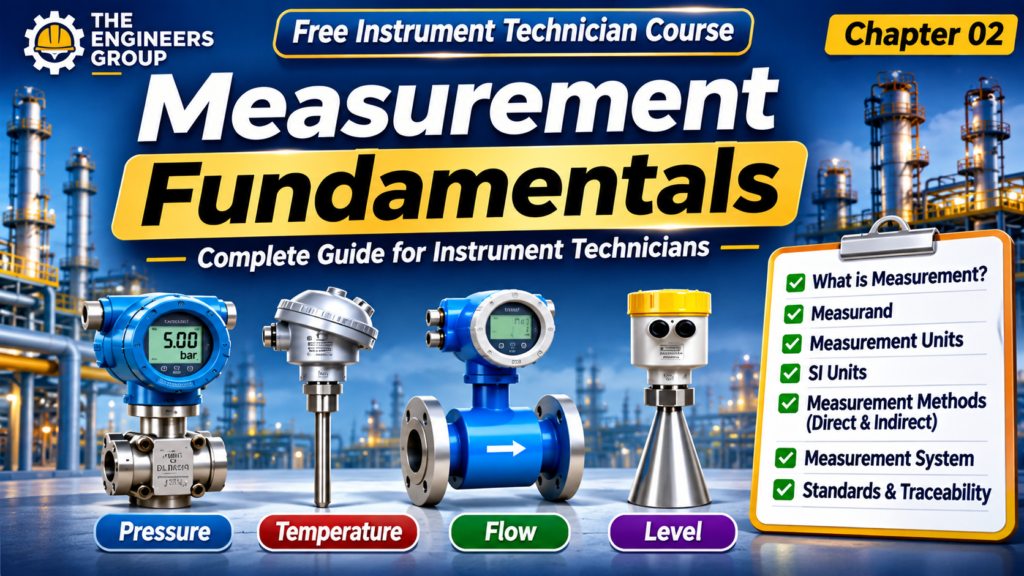
Measurement Fundamentals
Introduction
Measurement is one of the most important foundations of industrial instrumentation. Every industrial process requires accurate information about physical variables such as pressure, temperature, flow, level, speed and density.
Instrument technicians use measuring instruments to monitor these process variables, maintain operating conditions and help ensure safe and efficient plant operation.
Before learning individual instruments such as pressure transmitters, temperature sensors and flow meters, it is essential to understand the basic principles of measurement.
In this chapter, we will explore measurement fundamentals, measurands, measurement methods, units, standards, measuring systems and practical industrial applications.
1. What Is Measurement?
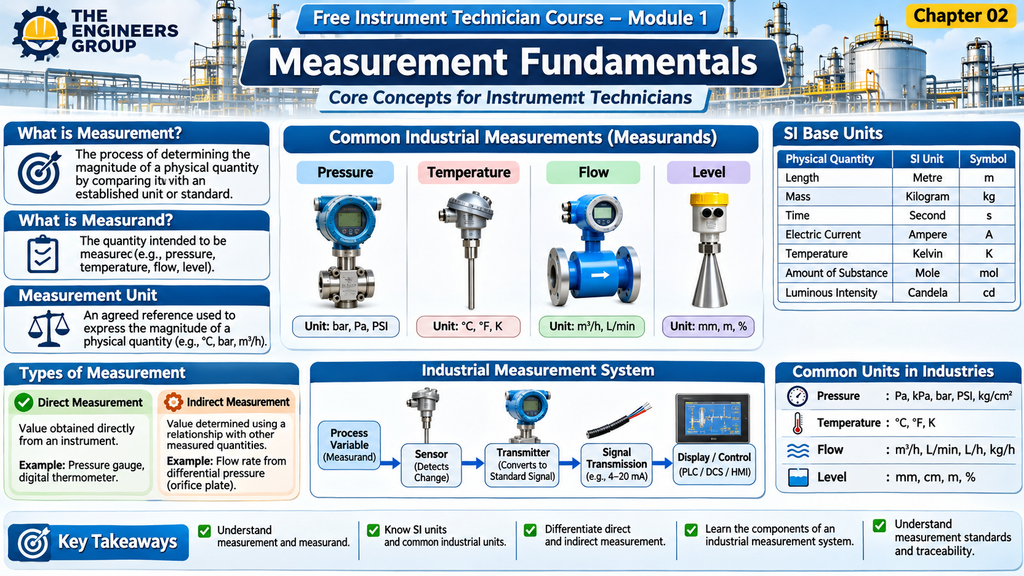
Measurement is the process of determining the magnitude of a physical quantity by comparing it with an established unit or standard.
In simple terms, measurement tells us how much of a particular quantity exists.
Examples:
- Measuring temperature using an RTD.
- Measuring pressure using a pressure transmitter.
- Measuring liquid flow using a magnetic flow meter.
- Measuring tank level using a level transmitter.
- Measuring electrical voltage using a digital multimeter.
For example, if a pressure gauge indicates 5 bar, it means the measured pressure is represented as 5 times the unit bar.
A measurement result normally includes a numerical value and a measurement unit.
📘 WANT TO LEARN INSTRUMENTATION PRACTICALLY?
Get our 380+ Pages Instrumentation Technician Complete Practical E-book.
BUY E-BOOK NOW2. What Is a Measurand?
A measurand is the quantity intended to be measured.
It is important to clearly identify the measurand before selecting or configuring a measuring instrument.
Examples:
| Application | Measurand |
|---|---|
| Pressure transmitter | Process pressure |
| RTD sensor | Temperature |
| Magnetic flow meter | Volumetric flow rate |
| Level transmitter | Liquid level |
| Load cell | Force or weight-related quantity |
For example, when installing a temperature transmitter on a pipeline, the measurand is the temperature of the process at the specified measurement location.
3. What Is a Measurement Unit?
A measurement unit is an agreed reference used to express the magnitude of a physical quantity.
Without standard units, measurement results would be difficult to compare and communicate.
For example:
- Temperature: °C or K
- Pressure: Pa or bar
- Length: m
- Mass: kg
- Time: s
- Electrical current: A
- Voltage: V
Different industries may use different practical units, but technicians must understand how to convert between them.
4. International System of Units (SI Units)
The International System of Units (SI) provides a globally accepted measurement system.
It contains seven base units.
| Physical Quantity | SI Unit | Symbol |
|---|---|---|
| Length | Metre | m |
| Mass | Kilogram | kg |
| Time | Second | s |
| Electric current | Ampere | A |
| Thermodynamic temperature | Kelvin | K |
| Amount of substance | Mole | mol |
| Luminous intensity | Candela | cd |
These base units are used to define many derived units in engineering and science.
Examples of derived units:
| Quantity | Unit | Symbol |
|---|---|---|
| Force | Newton | N |
| Pressure | Pascal | Pa |
| Energy | Joule | J |
| Power | Watt | W |
| Frequency | Hertz | Hz |
| Electric charge | Coulomb | C |
5. Common Industrial Measurement Units
Instrument technicians frequently work with different units depending on the process and equipment.
Pressure Units
- Pascal (Pa)
- Kilopascal (kPa)
- Bar
- PSI
- kg/cm²
- mmH₂O
Useful conversions:
- 1 bar = 100,000 Pa
- 1 bar = 100 kPa
- 1 bar ≈ 14.5038 PSI
- 1 bar ≈ 1.0197 kgf/cm²
Temperature Units
- Celsius (°C)
- Fahrenheit (°F)
- Kelvin (K)
Conversion formulas:
°F = (°C × 9/5) + 32
K = °C + 273.15
Flow Units
- m³/h
- L/min
- L/h
- kg/h
- t/h
Level Units
- mm
- cm
- m
- percentage (%)
- mmH₂O
Important: Always confirm the measurement unit and reference conditions before comparing process values.
6. Types of Measurement Methods
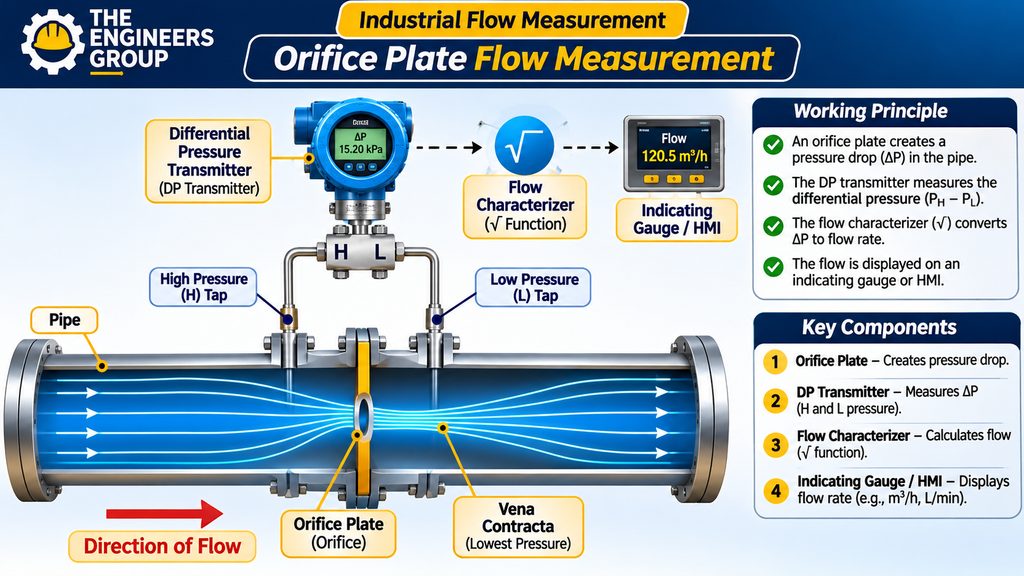
Measurement methods can be classified into different categories depending on how the quantity is determined.
A. Direct Measurement
In direct measurement, the value is obtained directly from an instrument without requiring a separate calculation based on another measured quantity.
Examples:
- Measuring temperature using a digital thermometer.
- Measuring voltage using a digital multimeter.
- Measuring pressure using a pressure gauge.
B. Indirect Measurement
In indirect measurement, the required quantity is determined using a relationship involving one or more other measured quantities.
Examples:
- Calculating flow rate from differential pressure across an orifice plate using an appropriate flow equation.
- Calculating density using measured mass and volume.
- Determining liquid level from hydrostatic pressure when liquid density is known or compensated for.
Industrial Example:
An orifice plate produces a differential pressure when fluid flows through it. A DP transmitter measures this differential pressure, and the flow rate is calculated using the configured measurement relationship.
Therefore, the flow rate is obtained indirectly from differential pressure.
7. What Is a Measurement System?
A measurement system is a combination of components used to detect, process, transmit and display a physical quantity.
A typical industrial measurement system contains the following stages:
- Primary sensing element
- Sensor or transducer
- Signal conditioning
- Signal transmission
- Display or control system
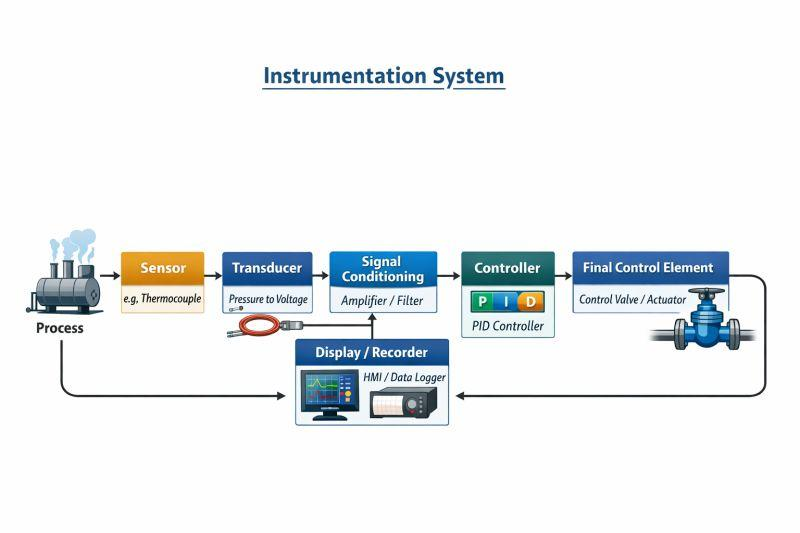
Example: Temperature Measurement System
Consider an industrial pipeline where temperature must be monitored.
Step 1 – Temperature Sensing
An RTD detects the temperature of the process.
Step 2 – Signal Conversion
The RTD produces a resistance that changes with temperature.
Step 3 – Signal Conditioning
A temperature transmitter converts the sensor signal into a standardized output, commonly 4–20 mA.
Step 4 – Signal Transmission
The electrical signal travels through the instrument cable to the control system.
Step 5 – Display
The PLC or DCS scales the signal and displays the temperature in °C.
8. Important Components of an Industrial Measurement System
1. Primary Sensing Element
The primary sensing element directly interacts with the process or responds to the physical quantity being measured.
Examples:
- Bourdon tube
- RTD element
- Thermocouple junction
- Orifice plate
- Float mechanism
2. Sensor
A sensor detects a physical quantity and produces a response related to that quantity.
Examples:
- RTD sensor
- Thermocouple
- Pressure sensing element
- Proximity sensor
3. Transducer
A transducer converts one form of energy or physical quantity into another form.
For example, a thermocouple converts a temperature difference into an electrical voltage.
4. Transmitter
A transmitter converts a sensor or measurement input into a standardized output signal for transmission to a control or monitoring system.
A common industrial output is 4–20 mA DC.
5. Signal Conditioner
Signal conditioning modifies a signal to make it suitable for further processing.
Functions may include amplification, filtering, isolation and linearization.
6. Indicator or Display
An indicator displays the measured value to the operator.
Examples include:
- Digital temperature indicator
- Pressure gauge
- Panel meter
- HMI display
💬 NEED GUIDANCE IN INSTRUMENTATION?
Contact THE ENGINEERS GROUP for eBook details, course information and learning support.
MESSAGE US ON WHATSAPP9. Analog and Digital Measurement
Industrial instruments use both analog and digital measurement techniques.
Analog Measurement
An analog signal varies continuously over a range.
Examples:
- 4–20 mA current signal
- 1–5 V voltage signal
- RTD resistance variation
A 4–20 mA signal is widely used in industrial process instrumentation.
Digital Measurement
A digital measurement system represents information using discrete numerical values.
Examples:
- Digital pressure indicator
- Digital temperature controller
- Smart transmitter with digital communication
- Digital multimeter
Digital instruments may offer configuration, diagnostics and communication capabilities depending on their design.
10. What Is Measurement Standardization?
Measurement standardization ensures that measurements are consistent, comparable and traceable to recognized references.
Without standardization, different instruments may produce results that cannot be reliably compared.
Important organizations and systems include:
- BIPM: Coordinates international measurement standards and the SI system.
- NIST: Maintains measurement standards and provides calibration-related services in the United States.
- ISO: Develops international standards for different industries and management systems.
- IEC: Develops international electrotechnical standards.
Instrument technicians should follow the applicable plant procedures, instrument specifications and calibration requirements.
11. What Is Measurement Traceability?
Metrological traceability is the property of a measurement result whereby it can be related to a reference through a documented, unbroken chain of calibrations, each contributing to measurement uncertainty.
In simple terms, a calibrated instrument should have measurement results traceable to recognized measurement standards through documented calibration records.
Industrial Example:
A pressure transmitter is calibrated using a pressure calibrator.
The pressure calibrator has its own valid calibration certificate, which establishes traceability to a recognized reference.
The calibration procedure and records help demonstrate the reliability of the transmitter measurement.
12. Practical Industrial Example – Pressure Measurement
Consider a process pipeline operating at a pressure of 6 bar.
A pressure transmitter is installed to continuously monitor the pipeline pressure.
Measurement process:
- Process pressure acts on the transmitter sensing element.
- The sensing element responds to the applied pressure.
- The transmitter processes the sensor signal.
- The transmitter generates a 4–20 mA output.
- The signal is transmitted to the PLC or DCS.
- The control system converts the signal into an engineering value.
- The operator monitors the pressure on the HMI.
If the transmitter range is 0–10 bar, a pressure of 6 bar corresponds to:
Output = 4 + [(6 − 0) / (10 − 0)] × 16
Output = 13.6 mA
This example assumes a linear 0–10 bar to 4–20 mA configuration and normal operation.
13. Why Are Measurement Fundamentals Important for Instrument Technicians?
Understanding measurement fundamentals helps technicians to:
- Select suitable measuring instruments.
- Understand engineering units.
- Interpret instrument readings.
- Perform calibration correctly.
- Identify measurement errors.
- Configure transmitter ranges.
- Understand analog and digital signals.
- Troubleshoot measurement problems.
- Maintain reliable process monitoring.
A strong understanding of measurement fundamentals is essential before learning advanced industrial instrumentation.
14. Common Measurement Mistakes in Industries
Some common problems include:
1. Incorrect Measurement Unit
Using bar instead of PSI without proper conversion may cause incorrect interpretation.
2. Wrong Instrument Range
Selecting a transmitter with an unsuitable range can reduce measurement usefulness or cause measurement saturation.
3. Incorrect Sensor Installation
Poor sensor positioning can result in measurements that do not represent the actual process condition.
4. Incorrect Scaling
If the PLC or DCS range does not match the transmitter configuration, the displayed value may be incorrect.
5. Poor Calibration Practice
Using unsuitable references or incorrect calibration procedures can affect measurement reliability.
6. Ignoring Process Conditions
Temperature, vibration, pressure pulsation, contamination and other environmental factors may influence measurement performance.
15. Interview Questions and Answers
Q1. What is measurement?
Measurement is the process of determining the magnitude of a physical quantity by comparing it with an established unit or standard.
Q2. What is a measurand?
A measurand is the specific quantity intended to be measured.
Q3. What are SI units?
SI units are internationally standardized units used to express physical quantities.
Q4. What is the SI unit of pressure?
The SI unit of pressure is Pascal (Pa).
Q5. What is the difference between direct and indirect measurement?
Direct measurement obtains a value directly from an instrument, while indirect measurement determines the value using a relationship involving other measured quantities.
Q6. What is a sensor?
A sensor detects a physical quantity and responds to changes in that quantity.
Q7. What is a transmitter?
A transmitter converts a measurement input into a standardized signal suitable for transmission to a control or monitoring system.
Q8. What is a measurement standard?
A measurement standard is a reference used to define, realize or reproduce a quantity for measurement and comparison.
Q9. What is measurement traceability?
It is the documented relationship of a measurement result to a recognized reference through an unbroken chain of calibrations.
Q10. Why is 4–20 mA commonly used in industries?
It provides a standardized analog signal with a live zero, which helps distinguish a zero measurement value from certain signal failures.
16. Multiple Choice Questions (MCQs)
Q1. What is measurement?
A. Controlling a process
B. Determining the magnitude of a quantity
C. Starting a motor
D. Stopping a machine
Correct Answer: B
Q2. What is the SI unit of temperature?
A. Celsius
B. Fahrenheit
C. Kelvin
D. Bar
Correct Answer: C
Q3. What is the SI unit of pressure?
A. PSI
B. Pascal
C. Bar
D. kg/cm²
Correct Answer: B
Q4. What is a measurand?
A. The quantity intended to be measured
B. An electrical cable
C. A control valve
D. A power supply
Correct Answer: A
Q5. Which instrument is commonly used to measure electrical voltage?
A. Pressure gauge
B. RTD
C. Digital multimeter
D. Flow meter
Correct Answer: C
Q6. Which is an example of indirect flow measurement?
A. Measuring voltage using a multimeter
B. Calculating flow using differential pressure across an orifice plate
C. Reading a digital clock
D. Measuring length using a ruler
Correct Answer: B
Q7. What is the SI unit of electric current?
A. Volt
B. Watt
C. Ampere
D. Ohm
Correct Answer: C
Q8. Which device commonly converts an RTD input into a 4–20 mA signal?
A. Temperature transmitter
B. Circuit breaker
C. Relay
D. Contactor
Correct Answer: A
Q9. Which organization coordinates international measurement standards and the SI system?
A. BIPM
B. PLC
C. SCADA
D. HMI
Correct Answer: A
Q10. What does measurement traceability establish?
A. Motor speed
B. A documented link to a recognized measurement reference
C. Pipe diameter
D. Electrical frequency
Correct Answer: B
17. Chapter Summary
In this chapter, we learned the basic principles of industrial measurement.
Important concepts covered include:
- Definition of measurement and measurand.
- Measurement units and SI units.
- Direct and indirect measurement methods.
- Industrial measurement systems.
- Sensors, transducers and transmitters.
- Analog and digital measurement.
- Measurement standards and traceability.
- Practical pressure measurement.
- Common measurement mistakes.
These fundamentals provide the foundation for understanding individual industrial instruments and their applications.
18. What Is Next?
In the next chapter, we will study Accuracy, Precision and Resolution.
We will understand how to evaluate measurement quality, identify differences between accuracy and precision, and interpret instrument specifications using practical industrial examples.
Continue learning with THE ENGINEERS GROUP – Free Instrument Technician Course.
Learn. Practice. Improve. Grow.
“`htmlCONNECT WITH THE ENGINEERS GROUP
Learn. Practice. Improve. Grow.
📘 BUY INSTRUMENTATION E-BOOK 💬 CONTACT US ON WHATSAPP ▶ SUBSCRIBE ON YOUTUBE f FOLLOW US ON FACEBOOKTHE ENGINEERS GROUP
Free Engineering Education for Everyone