PLC Programming Course – Chapter 04: Types of PLC and Their Applications
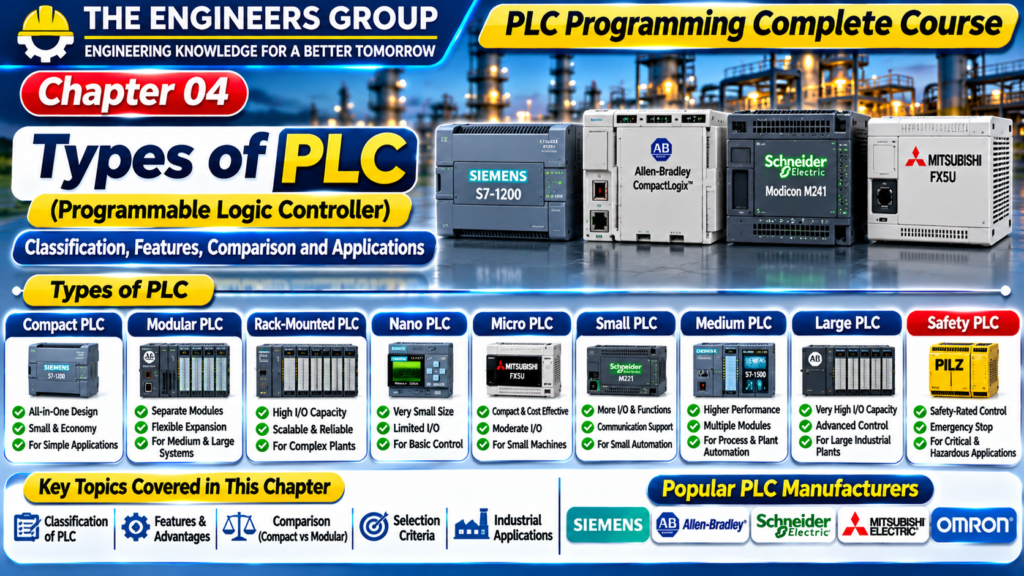
PLC Programming Course – Chapter 04
Table of Contents
- Introduction to Types of PLC
- What Is a PLC?
- Classification of PLC
- Compact PLC
- Modular PLC
- Rack-Mounted PLC
- Nano PLC
- Micro PLC
- Small PLC
- Medium PLC
- Large PLC
- Safety PLC
- Difference Between Compact and Modular PLC
- Difference Between Micro, Small, Medium and Large PLC
- Factors for Selecting the Right PLC
- Industrial Applications of Different PLC Types
- Popular PLC Manufacturers and Their PLC Families
- Advantages and Limitations of Different PLC Types
- PLC Selection – Practical Industrial Example
- PLC Types Interview Questions and Answers
- PLC Types MCQs
- Chapter Summary
- What You Will Learn in Chapter 05
1. Introduction to Types of PLC
Programmable Logic Controllers (PLCs) are widely used in industrial automation to control machines, production lines, and industrial processes.
PLCs are available in different types and configurations depending on application requirements, number of input/output points, processing capacity, communication requirements, and system complexity.
A small machine may require only a compact PLC with a limited number of I/O points, while a large manufacturing plant may require a modular or rack-mounted PLC with multiple communication and I/O modules.
Understanding the different Types of PLC helps engineers and technicians select the correct controller for an industrial application.
In this chapter, we will study the major PLC types, their construction, features, advantages, limitations, and practical applications.
2. What Is a PLC?
PLC stands for Programmable Logic Controller.
It is an industrial digital controller designed to monitor input signals, execute a programmed control strategy, and operate output devices.
A PLC generally consists of:
- Central Processing Unit (CPU)
- Power Supply
- Memory
- Digital Input Modules
- Digital Output Modules
- Analog Input Modules
- Analog Output Modules
- Communication Interfaces
Basic Working Principle
The PLC receives signals from field devices such as push buttons, sensors, and transmitters.
The CPU processes these signals according to the user program and sends control commands to output devices such as motors, contactors, solenoid valves, and alarms.
Basic Process:
Input Devices → PLC → Output Devices
CONNECT WITH THE ENGINEERS GROUP
Learn. Practice. Improve. Grow.
📘 EXPLORE OUR EBOOK 💬 CONTACT US ON WHATSAPP ▶️ SUBSCRIBE ON YOUTUBE FOLLOW US ON FACEBOOKTHE ENGINEERS GROUP
Free Engineering Education for Everyone
3. Classification of PLC
PLCs can be classified in different ways depending on their physical construction, size, I/O capacity, and intended application.
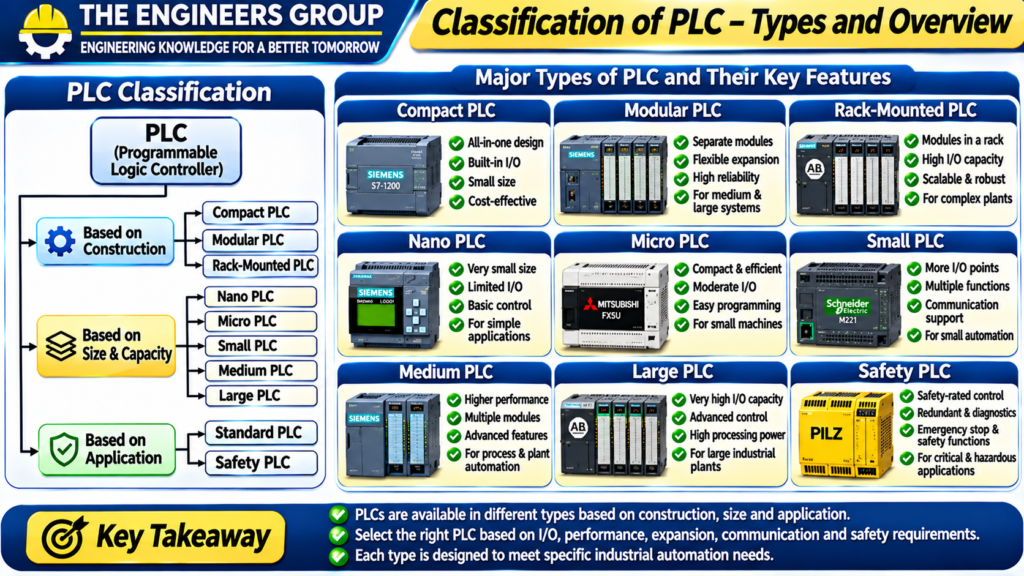
Classification Based on Construction
- Compact PLC
- Modular PLC
- Rack-Mounted PLC
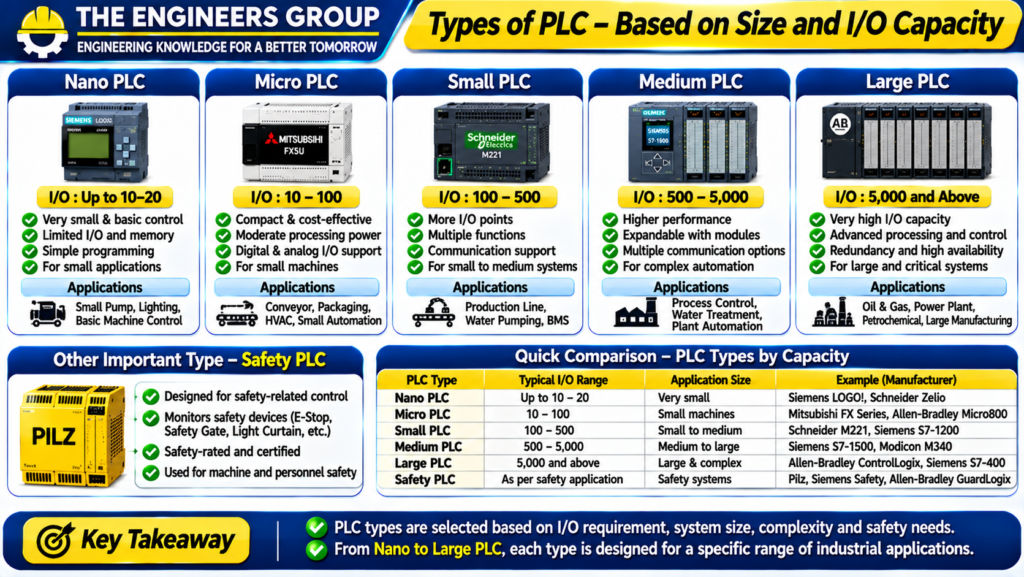
Classification Based on Size and Capacity
- Nano PLC
- Micro PLC
- Small PLC
- Medium PLC
- Large PLC
Classification Based on Application
- Standard PLC
- Safety PLC
Important: These classifications are not completely separate categories. For example, a Micro PLC may also be a Compact PLC. Similarly, a Rack-Mounted PLC is generally a form of Modular PLC. The actual classification depends on the manufacturer’s product range.
4. Compact PLC
A Compact PLC is a controller in which major components such as the CPU, power supply, and a basic number of input/output points are integrated into a single housing.
It is commonly used for small and medium-sized machine automation applications.
<image-placeholder>Compact PLC hardware with integrated CPU and I/O</image-placeholder>
Main Features of Compact PLC
- Integrated CPU and I/O.
- Small physical size.
- Simple installation.
- Lower hardware complexity.
- Suitable for basic automation applications.
- Limited or model-dependent expansion capability.
Advantages of Compact PLC
- Compact design.
- Easy installation and commissioning.
- Suitable for small control panels.
- Often economical for simple applications.
- Requires less mounting space.
Limitations of Compact PLC
- Limited built-in I/O capacity.
- Expansion options may be restricted.
- Less flexible for large automation systems.
- Hardware replacement may require replacing a larger integrated unit.
Applications of Compact PLC
- Small Conveyor Systems
- Water Pump Control
- Packaging Machines
- Small HVAC Systems
- Automatic Doors
- Small Industrial Machines
Example
A small water pumping station may use a Compact PLC to control pump operation, monitor tank level switches, and activate alarms.
5. Modular PLC
A Modular PLC consists of separate hardware modules that are installed and connected according to the application requirements.
The system may contain a separate CPU, power supply, digital I/O modules, analog I/O modules, and communication modules.
<image-placeholder>Modular PLC with separate CPU, power supply and I/O modules</image-placeholder>
Main Components
1. Power Supply Module
Provides the required operating power to the PLC system.
2. CPU Module
Executes the user program and controls the PLC operation.
3. Digital Input Module
Receives ON/OFF signals from field devices.
4. Digital Output Module
Controls devices such as relays, contactors, and solenoid valves.
5. Analog Input Module
Receives continuous signals such as 4–20 mA and 0–10 V.
6. Analog Output Module
Generates analog control signals for devices such as VFDs and control valve positioners.
7. Communication Module
Provides communication with other controllers, HMIs, SCADA systems, and industrial networks.
Advantages of Modular PLC
- Flexible hardware configuration.
- Expandable I/O capacity.
- Easier replacement of individual modules.
- Supports different communication interfaces.
- Suitable for complex automation applications.
- Allows customized hardware arrangements.
Limitations of Modular PLC
- Higher hardware cost in many configurations.
- Requires more panel space.
- Hardware configuration is more complex.
- Requires proper module selection and compatibility checks.
Applications of Modular PLC
- Manufacturing Plants
- Water Treatment Plants
- Industrial Packaging Lines
- Material Handling Systems
- Process Automation
- Machine Control Systems
6. Rack-Mounted PLC
A Rack-Mounted PLC is a type of modular PLC in which separate modules are installed in a rack or chassis.
The rack provides physical mounting and an internal connection system for compatible modules.
<image-placeholder>Industrial rack-mounted PLC with CPU, power supply, digital and analog I/O modules</image-placeholder>
Main Components
- PLC Rack or Chassis
- Power Supply
- CPU
- Digital Input Modules
- Digital Output Modules
- Analog Input Modules
- Analog Output Modules
- Communication Modules
Working Principle
- The power supply provides the required electrical power.
- The CPU executes the control program.
- Input modules receive signals from field devices.
- The CPU processes the input information.
- Output modules send commands to external devices.
- Communication modules exchange information with other automation systems.
Advantages of Rack-Mounted PLC
- Supports large I/O configurations.
- Provides flexible module arrangement.
- Suitable for complex control systems.
- Supports communication and specialized modules.
- Allows expansion based on system requirements.
Limitations
- Requires larger control panel space.
- Hardware configuration can be more complex.
- Initial investment may be higher.
- Requires careful module and rack planning.
Applications
- Large Manufacturing Plants
- Automotive Production Lines
- Power Generation Facilities
- Oil and Gas Plants
- Chemical Processing
- Large Industrial Automation Systems
7. Nano PLC
A Nano PLC is a very small programmable controller designed for simple automation applications with limited I/O requirements.
Some manufacturers use different product names for their smallest PLC families, so Nano PLC is not a universal hardware category with a fixed I/O limit.
Main Features
- Very small physical size.
- Limited input and output points.
- Basic control functions.
- Simple programming requirements.
- Suitable for small standalone applications.
Applications
- Small Pump Control
- Automatic Lighting
- Small Machines
- Simple Conveyor Control
- Basic Equipment Automation
Advantages
- Small installation space.
- Simple control architecture.
- Suitable for basic applications.
- Often economical for simple systems.
Limitations
- Limited processing and memory capacity.
- Restricted I/O options.
- Limited expansion on some models.
- May not support complex communication requirements.
8. Micro PLC
A Micro PLC is a small programmable controller designed for compact industrial machines and applications requiring a moderate number of I/O points.
Micro PLCs commonly provide more programming and communication capabilities than very small controllers, depending on the product family.
Main Features
- Compact hardware.
- Integrated or expandable I/O.
- Digital and sometimes analog I/O support.
- Communication capabilities.
- Suitable for machine-level automation.
Applications
- Small Packaging Machines
- Conveyor Systems
- Pumping Stations
- Small Assembly Machines
- HVAC Control
- Material Handling
Advantages
- Compact installation.
- Suitable for small machine control.
- Easier configuration than large PLC systems.
- Can support communication with HMI and other devices.
Limitations
- Limited processing capacity compared with larger PLC families.
- Restricted expansion depending on model.
- May not be suitable for very large systems.
9. Small PLC
Small PLCs are designed for applications with a relatively limited number of control points and moderate program complexity.
They may be compact controllers or small modular systems.
Main Features
- Small to moderate I/O capacity.
- Basic and intermediate control functions.
- Support for common communication protocols.
- Suitable for standalone machines and small systems.
Applications
- Small Production Lines
- Water Pumping Systems
- Conveyor Automation
- Packaging Machines
- Building Automation
10. Medium PLC
Medium PLCs are designed for larger machines and industrial processes requiring more I/O points, memory, processing performance, and communication capabilities.
They often use modular hardware configurations.
Main Features
- Higher I/O capacity than many small PLCs.
- Expandable hardware architecture.
- Multiple communication options.
- Support for more complex programs.
- Suitable for multi-machine automation.
Applications
- Production Lines
- Water Treatment Plants
- Industrial Process Control
- Material Handling Systems
- Manufacturing Automation
11. Large PLC
Large PLCs are designed for complex industrial automation systems that require extensive I/O, high processing capability, and advanced communication.
They commonly use modular or rack-based hardware configurations.
Main Features
- High I/O capacity.
- Large program and data capacity.
- Advanced communication capabilities.
- Support for distributed I/O systems.
- Suitable for complex machine and process control.
Applications
- Automotive Manufacturing
- Large Chemical Plants
- Power Plants
- Oil and Gas Facilities
- Steel and Cement Industries
- Large Production Facilities
Note: There is no single universal I/O point limit that defines Nano, Micro, Small, Medium, or Large PLCs. Manufacturers classify their product families differently.
12. Safety PLC
A Safety PLC is a specialized programmable controller designed to implement safety-related control functions.
It is used where machinery or industrial processes require safety functions to reduce risks to people and equipment.
Safety PLCs are designed and certified for specified functional safety requirements.
Main Safety Functions
- Emergency Stop Monitoring
- Safety Gate Monitoring
- Light Curtain Monitoring
- Two-Hand Control
- Safe Machine Shutdown
- Safety Interlocking
Main Features
- Safety-rated hardware and software.
- Diagnostic monitoring.
- Redundant or fault-tolerant architecture where required.
- Safety function validation.
- Support for safety-related communication in compatible systems.
Applications
- Robotic Cells
- Automotive Production Lines
- Packaging Machines
- Industrial Presses
- Material Handling Systems
- Hazardous Machinery
Important: A standard PLC is not automatically suitable for safety functions. Safety-related applications require appropriately certified equipment, engineering, validation, and compliance with applicable safety standards.
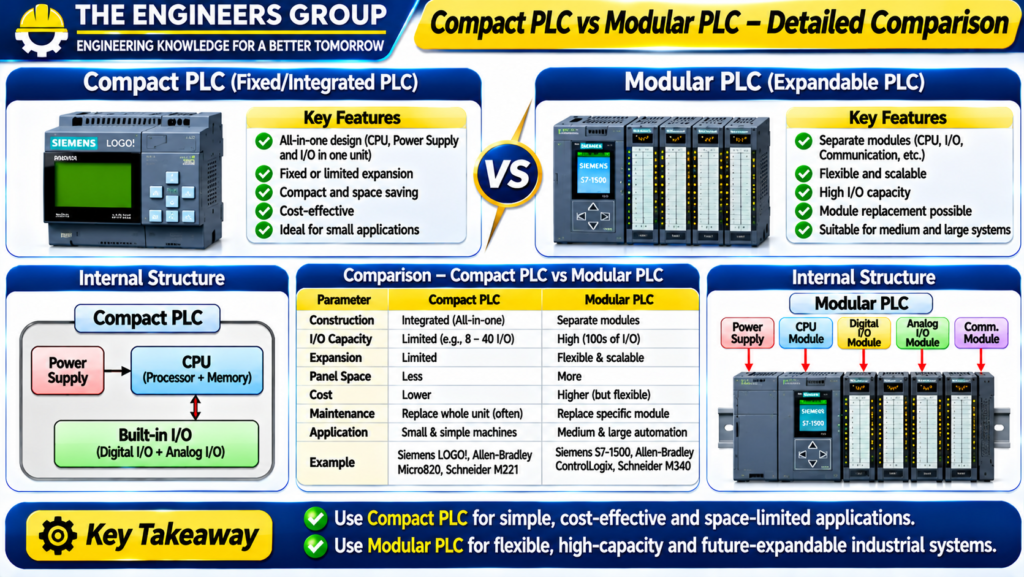
13. Difference Between Compact and Modular PLC
| Parameter | Compact PLC | Modular PLC |
|---|---|---|
| Construction | Integrated housing | Separate modules |
| CPU | Usually integrated | Separate CPU module in many systems |
| I/O | Built-in or limited expansion | Configurable and expandable |
| Installation | Simple | Requires module arrangement |
| Panel Space | Usually less | Depends on configuration |
| Flexibility | Lower | Higher |
| Maintenance | May require larger unit replacement | Individual modules can often be replaced |
| Application | Small and medium machines | Medium and large systems |
14. Difference Between Micro, Small, Medium and Large PLC
| Parameter | Micro PLC | Small PLC | Medium PLC | Large PLC |
|---|---|---|---|---|
| Application | Small machines | Small systems | Complex machines | Large plants |
| I/O Capacity | Limited | Low to moderate | Moderate to high | High |
| Program Complexity | Basic | Basic to intermediate | Intermediate to advanced | Advanced |
| Expansion | Model-dependent | Model-dependent | Generally flexible | Highly configurable |
| Processing Requirements | Low to moderate | Moderate | Higher | High |
| Typical Architecture | Compact | Compact or modular | Often modular | Often rack-based or modular |
These categories are general descriptions. Always check the manufacturer’s specifications rather than selecting a PLC based only on its size classification.
15. Factors for Selecting the Right PLC
Selecting the correct PLC is important for reliable industrial automation.
The following factors should be considered.
1. Number of I/O Points
Calculate the total number of digital and analog inputs and outputs required.
Also consider spare I/O for future expansion.
2. CPU Performance
Select a CPU according to program complexity, processing time, communication load, and application requirements.
3. Memory Capacity
Check the memory requirements for the user program, data, recipes, and other application information.
4. Communication Requirements
Determine whether the application requires:
- PROFINET
- PROFIBUS
- Modbus RTU
- Modbus TCP
- EtherNet/IP
- Other supported protocols
5. Expansion Requirements
Consider whether additional I/O, communication, or specialized modules may be required in the future.
6. Environmental Conditions
Check:
- Operating Temperature
- Humidity
- Vibration
- Electrical Noise
- Enclosure Requirements
- Power Supply Conditions
7. Safety Requirements
Determine whether the application requires a standard PLC, a Safety PLC, or a separate safety system.
8. Software and Support
Check engineering software availability, programming skills, spare parts, technical support, and maintenance requirements.
16. Industrial Applications of Different PLC Types
Different PLC types are selected according to the complexity and scale of industrial applications.
| Industry | PLC Type Example | Application |
|---|---|---|
| Small Packaging | Compact PLC | Machine control |
| Water Pumping | Micro or Compact PLC | Pump automation |
| Manufacturing | Modular PLC | Production line control |
| Automotive | Modular or Rack-Mounted PLC | Assembly automation |
| Power Generation | Modular or specialized control system | Auxiliary equipment control |
| Oil and Gas | Suitable industrial controller | Process and equipment control |
| Water Treatment | Modular PLC | Pump, valve and process control |
| Cement Industry | Modular or large PLC | Plant automation |
The final selection depends on the process, safety requirements, I/O count, communication architecture, and manufacturer specifications.
17. Popular PLC Manufacturers and Their PLC Families
Several manufacturers provide PLC systems for different industrial applications.
17.1 Siemens
Siemens provides PLC families such as:
- LOGO! – Logic modules for simple automation tasks.
- SIMATIC S7-1200 – Compact PLC family.
- SIMATIC S7-1500 – Advanced modular controller family.
- SIMATIC S7-300 – Legacy modular PLC family.
- SIMATIC S7-400 – Legacy high-performance PLC family.
17.2 Rockwell Automation (Allen-Bradley)
Popular PLC product families include:
- Micro800
- MicroLogix – Legacy family
- CompactLogix
- ControlLogix
These controllers are used in different machine and plant automation applications.
17.3 Schneider Electric
Popular product families include:
- Modicon M221
- Modicon M241
- Modicon M251
- Modicon M340
- Modicon M580
17.4 Mitsubishi Electric
Popular PLC families include:
- MELSEC FX Series
- MELSEC iQ-F Series
- MELSEC iQ-R Series
17.5 Omron
Popular PLC families include:
- CP Series
- CJ Series
- NX Series
- NJ Series
Note: Product availability and support vary by region and model. Some older PLC families are legacy products, so check the manufacturer’s current documentation before selecting hardware for a new installation.
18. Advantages and Limitations of Different PLC Types
Compact PLC
Advantages:
- Small size.
- Easy installation.
- Suitable for basic applications.
Limitations:
- Limited expansion.
- Less flexible hardware configuration.
Modular PLC
Advantages:
- Flexible I/O configuration.
- Expandable architecture.
- Individual module replacement.
Limitations:
- More hardware components.
- Higher configuration complexity.
Rack-Mounted PLC
Advantages:
- Supports complex systems.
- Flexible module arrangement.
- Suitable for large I/O configurations.
Limitations:
- Requires more panel space.
- Higher initial hardware and engineering requirements.
Safety PLC
Advantages:
- Designed for safety-related control.
- Provides diagnostic capabilities.
- Supports certified safety functions.
Limitations:
- Higher engineering and validation requirements.
- Requires specialized safety knowledge.
- Must be selected according to the required safety level.
19. PLC Selection – Practical Industrial Example
Let’s consider a manufacturing facility that needs PLC control for three different applications.
Application 1: Small Water Pump
Requirements:
- Start and Stop Control
- Tank Level Switches
- Motor Contactor
- Basic Alarm
Suitable Choice: A Compact or Micro PLC with sufficient I/O and required communication features.
Application 2: Packaging Machine
Requirements:
- Multiple Sensors
- Conveyor Motors
- Pneumatic Valves
- Timers and Counters
- HMI Communication
Suitable Choice: A Compact PLC with adequate expansion or a small Modular PLC, depending on I/O and processing requirements.
Application 3: Large Manufacturing Plant
Requirements:
- Hundreds of I/O Points
- Multiple Remote I/O Stations
- Several VFDs
- HMI and SCADA Communication
- Advanced Control Logic
Suitable Choice: A Modular or Rack-Mounted PLC system with suitable CPU performance and communication capabilities.
The final selection should always be based on an engineering assessment of the actual application.
FREE 100 PLC INTERVIEW Q&A PDF DOWNLOAD
Download your free PLC learning material.
📥 DOWNLOAD FREE PLC PDFTHE ENGINEERS GROUP
20. PLC Types Interview Questions and Answers
Q1. What are the main types of PLC?
Common types include Compact PLC, Modular PLC, Rack-Mounted PLC, and Safety PLC. PLCs are also classified by size and capacity.
Q2. What is a Compact PLC?
A Compact PLC integrates major components such as CPU, power supply, and a basic number of I/O points into a single housing.
Q3. What is a Modular PLC?
A Modular PLC uses separate hardware modules that can be selected and arranged according to application requirements.
Q4. What is a Rack-Mounted PLC?
A Rack-Mounted PLC is a modular PLC system in which compatible modules are installed in a rack or chassis.
Q5. What is a Nano PLC?
A Nano PLC is a very small controller used for simple automation applications with limited I/O requirements.
Q6. What is a Micro PLC?
A Micro PLC is a small controller designed for compact machines and applications with relatively limited I/O requirements.
Q7. What is a Small PLC?
A Small PLC is used for relatively simple automation systems with a limited number of I/O points and moderate program complexity.
Q8. What is a Medium PLC?
A Medium PLC is designed for more complex machines and processes requiring greater I/O and processing capacity.
Q9. What is a Large PLC?
A Large PLC is designed for complex industrial systems with extensive I/O, communication, and processing requirements.
Q10. What is a Safety PLC?
A Safety PLC is a specialized controller designed for safety-related control functions.
Q11. What is the main difference between Compact and Modular PLC?
A Compact PLC integrates major components in one housing, while a Modular PLC uses separate hardware modules.
Q12. Which PLC is suitable for a small machine?
A Compact or Micro PLC may be suitable, depending on the required I/O, processing, and communication features.
Q13. Which PLC is suitable for a large manufacturing plant?
A Modular or Rack-Mounted PLC is commonly considered for large applications.
Q14. What is the advantage of a Modular PLC?
It provides flexible hardware configuration and allows expansion using compatible modules.
Q15. What is the function of a PLC rack?
A PLC rack holds compatible modules and provides internal connections between them.
Q16. Can a Compact PLC be expanded?
Some Compact PLCs support expansion modules, while others have limited or no expansion capability. This depends on the model.
Q17. What is the difference between Micro and Large PLC?
Micro PLCs are intended for smaller applications, while Large PLCs support more complex systems with higher I/O and processing requirements.
Q18. Name some popular PLC manufacturers.
Siemens, Rockwell Automation, Schneider Electric, Mitsubishi Electric, and Omron are major PLC manufacturers.
Q19. What factors should be considered when selecting a PLC?
I/O count, CPU performance, memory, communication, expansion, environment, safety requirements, and engineering support.
Q20. Is every Modular PLC a Rack-Mounted PLC?
Not necessarily. Modular PLCs use separate modules, but their physical mounting and connection arrangements vary by manufacturer.
21. PLC Types MCQs
Q1. Which PLC integrates major components into one housing?
A. Modular PLC
B. Compact PLC
C. Rack-Mounted PLC
D. Large PLC
Correct Answer: B. Compact PLC
Q2. Which PLC uses separate hardware modules?
A. Compact PLC
B. Modular PLC
C. Nano PLC only
D. None
Correct Answer: B. Modular PLC
Q3. Which PLC uses a rack or chassis to mount compatible modules?
A. Rack-Mounted PLC
B. Nano PLC
C. Compact PLC only
D. Relay Controller
Correct Answer: A. Rack-Mounted PLC
Q4. Which controller is designed for safety-related control functions?
A. Standard Compact PLC
B. Safety PLC
C. Nano PLC
D. Micro PLC
Correct Answer: B. Safety PLC
Q5. Which PLC is generally suitable for a simple standalone machine?
A. Compact PLC
B. Large PLC only
C. Mainframe Computer
D. None
Correct Answer: A. Compact PLC
Q6. Which PLC configuration generally offers flexible module expansion?
A. Modular PLC
B. Fixed PLC only
C. Relay Logic
D. Mechanical Timer
Correct Answer: A. Modular PLC
Q7. What does CPU stand for?
A. Central Processing Unit
B. Control Power Unit
C. Communication Process Unit
D. Central Programming Utility
Correct Answer: A. Central Processing Unit
Q8. Which PLC type is commonly considered for a large industrial plant?
A. Nano PLC
B. Modular or Rack-Mounted PLC
C. Basic Timer
D. Relay Panel Only
Correct Answer: B. Modular or Rack-Mounted PLC
Q9. Which is a popular Siemens compact PLC family?
A. S7-1200
B. ControlLogix
C. Modicon M580
D. MELSEC iQ-R
Correct Answer: A. S7-1200
Q10. Which is a Rockwell Automation PLC family?
A. S7-1500
B. CompactLogix
C. Modicon M221
D. MELSEC FX
Correct Answer: B. CompactLogix
Q11. Which manufacturer produces the Modicon PLC family?
A. Siemens
B. Schneider Electric
C. Omron
D. Mitsubishi Electric
Correct Answer: B. Schneider Electric
Q12. Which manufacturer produces the MELSEC PLC family?
A. Mitsubishi Electric
B. Rockwell Automation
C. Siemens
D. Schneider Electric
Correct Answer: A. Mitsubishi Electric
Q13. Which factor is important when selecting a PLC?
A. I/O requirements
B. CPU performance
C. Communication requirements
D. All of the above
Correct Answer: D. All of the above
Q14. Are Micro, Small, Medium and Large PLC categories defined using one universal I/O limit?
A. Yes
B. No
C. Only for Siemens
D. Only for Rockwell
Correct Answer: B. No
Q15. Which PLC type is commonly used for a large number of configurable I/O modules?
A. Nano PLC
B. Modular PLC
C. Basic relay
D. Simple timer
Correct Answer: B. Modular PLC
22. Chapter Summary
In this chapter, we learned about the different Types of PLC used in industrial automation.
We studied Compact PLC, Modular PLC, Rack-Mounted PLC, Nano PLC, Micro PLC, Small PLC, Medium PLC, Large PLC, and Safety PLC.
We also explored their construction, features, advantages, limitations, industrial applications, and selection criteria.
Understanding different PLC types helps engineers and technicians select suitable controllers for small machines, production lines, and large industrial plants.
23. What You Will Learn in Chapter 05
In the next chapter, we will study:
PLC Input and Output Modules
Topics will include:
- Introduction to PLC Input and Output Modules
- Digital Input Modules
- Digital Output Modules
- Analog Input Modules
- Analog Output Modules
- Input and Output Module Functions
- Module Selection and Configuration
- PLC I/O Module Wiring Basics
- Practical Industrial Examples
- Interview Questions and MCQs
Continue learning with THE ENGINEERS GROUP.
THE ENGINEERS GROUP
ENGINEERING KNOWLEDGE FOR A BETTER TOMORROW
Learn. Practice. Grow.
CONNECT WITH THE ENGINEERS GROUP
Learn. Practice. Improve. Grow.
📘 EXPLORE OUR EBOOK 💬 CONTACT US ON WHATSAPP ▶️ SUBSCRIBE ON YOUTUBE FOLLOW US ON FACEBOOKTHE ENGINEERS GROUP
Free Engineering Education for Everyone