Role and Responsibilities of Instrument Technician – Complete Industrial Guide
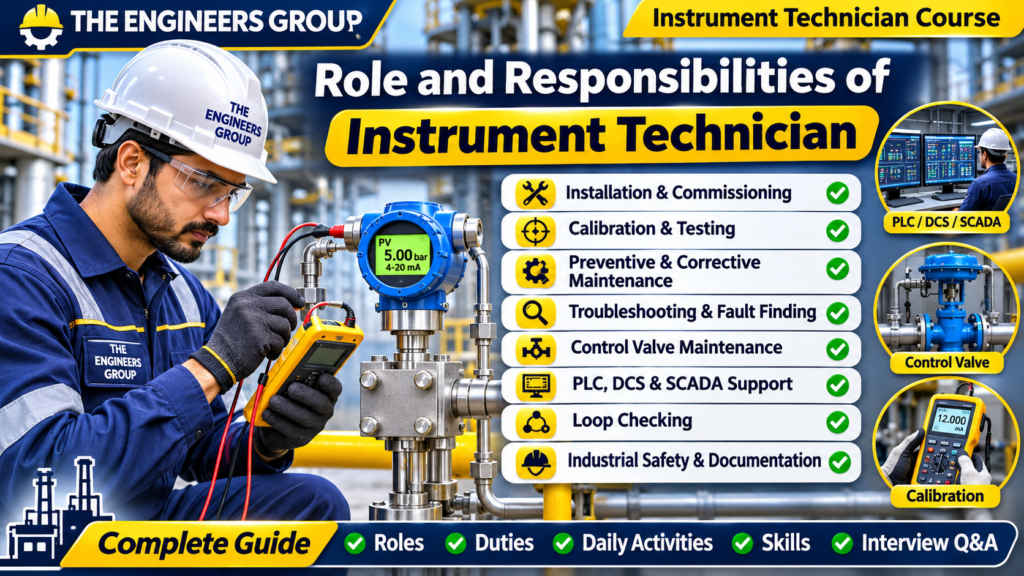
Role and Responsibilities of Instrument Technician – Chapter – 02
Table of Contents
- Introduction to Instrument Technician
- Who Is an Instrument Technician?
- Role of an Instrument Technician in Industry
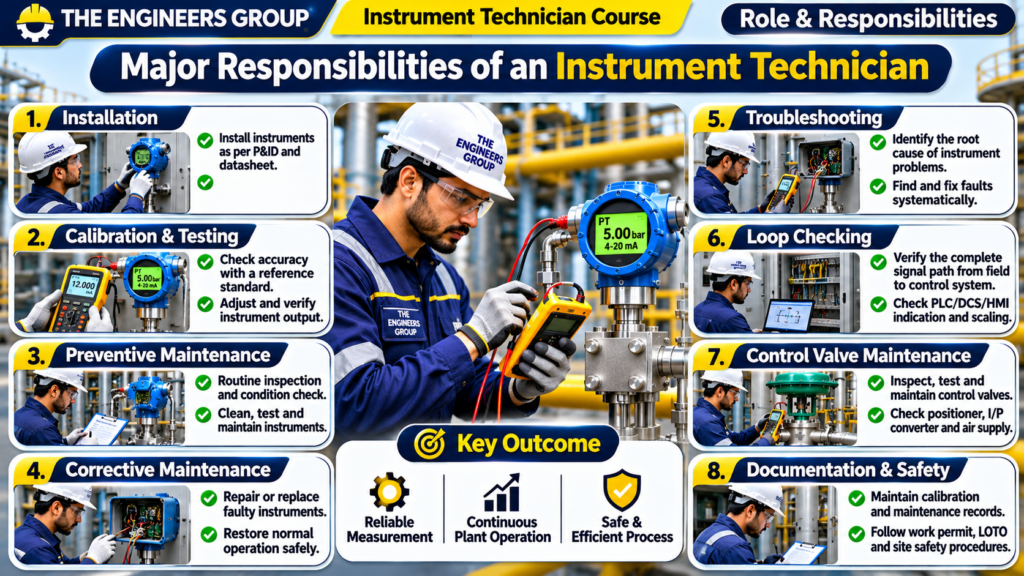
- Major Responsibilities of Instrument Technician
- Instrument Installation and Commissioning
- Instrument Calibration and Testing
- Preventive and Corrective Maintenance
- Instrument Troubleshooting and Fault Finding
- PLC, DCS, SCADA and Control System Monitoring
- Control Valve Inspection and Maintenance
- Instrument Loop Checking
- Industrial Safety and Work Permit
- Instrument Drawings and Documentation
- Tools and Equipment Used by Instrument Technicians
- Daily Activities of an Instrument Technician
- Skills Required to Become an Instrument Technician
- Industries Where Instrument Technicians Work
- Common Challenges Faced by Instrument Technicians
- Importance of Instrument Technicians in Industrial Plants
- Instrument Technician Interview Questions and Answers
- Multiple Choice Questions (MCQs)
- Chapter Summary
1. Introduction to Instrument Technician
Industrial plants depend on accurate measurement and reliable control systems to maintain safe, efficient and continuous production.
In industries such as oil and gas, power plants, chemical processing, pharmaceuticals, cement, steel and manufacturing, different process parameters must be continuously monitored and controlled.
These parameters include:
- Pressure
- Temperature
- Flow
- Level
- pH
- Conductivity
- Speed
- Vibration
Industrial instruments such as pressure transmitters, temperature sensors, flow meters, level transmitters, control valves and analytical instruments are used to measure and control these parameters.
An Instrument Technician plays an important role in installing, inspecting, testing, calibrating, maintaining and troubleshooting these instruments.
Without properly maintained instrumentation systems, industrial processes may experience inaccurate measurements, equipment failures, production losses and safety risks.
Therefore, Instrument Technicians are essential members of industrial maintenance and engineering teams.
2. Who Is an Instrument Technician?
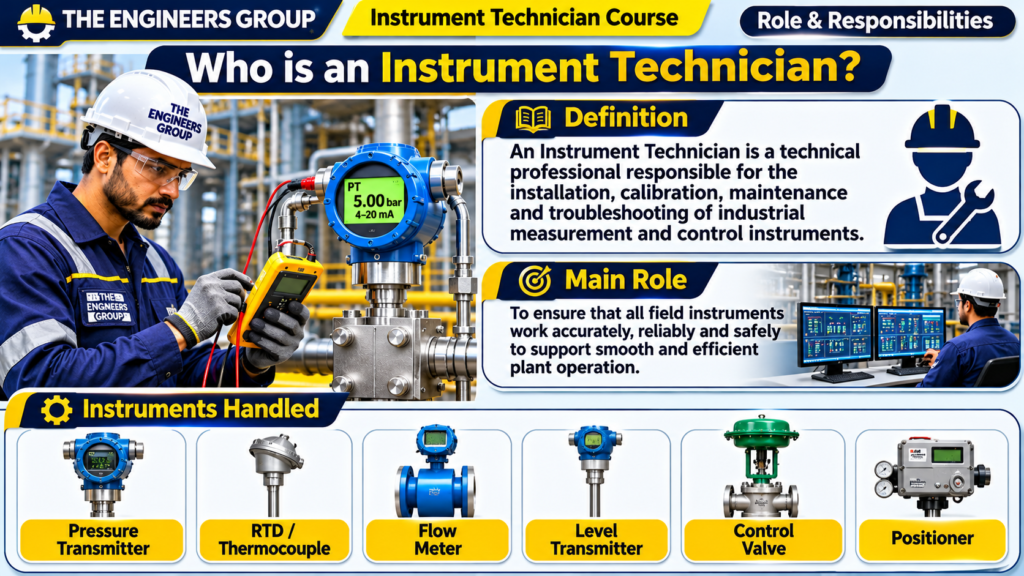
An Instrument Technician is a technical professional responsible for maintaining industrial measurement and control instruments.
Their main responsibility is to ensure that instruments operate correctly and provide reliable signals to control systems.
For example:
A pressure transmitter installed on a process pipeline measures pressure and sends a 4–20 mA signal to a PLC or DCS.
The Instrument Technician ensures that:
- The transmitter is installed correctly.
- The pressure sensing connection is in proper condition.
- The instrument is calibrated.
- The output signal is correct.
- The wiring and termination are healthy.
- The PLC or DCS receives the correct signal.
- Instrument faults are identified and corrected safely.
Understanding the role and responsibilities of instrument technician helps students and working professionals develop the practical skills required for industrial installation, calibration, preventive maintenance and troubleshooting..
3. Role of an Instrument Technician in Industry
The role and responsibilities of instrument technician are essential for maintaining reliable measurement, safe operations and efficient industrial plant performance. Technicians ensure that field instruments and control systems operate according to their required specifications.
The major roles include:
3.1 Instrument Installation
Installing industrial instruments according to engineering drawings, manufacturer instructions and approved procedures.
Examples:
- Pressure Transmitter Installation
- Temperature Sensor Installation
- Flow Meter Installation
- Level Transmitter Installation
- Control Valve Installation
The role and responsibilities of instrument technician also include regular inspection, instrument testing, fault diagnosis and coordination with other maintenance teams to ensure reliable industrial operations.
3.2 Instrument Calibration
Checking instrument accuracy against a suitable calibrated reference standard and performing adjustments when required and authorized.
Examples:
- Pressure Transmitter Calibration
- Temperature Transmitter Calibration
- Differential Pressure Transmitter Calibration
- Pressure Gauge Calibration
- Temperature Indicator Calibration
3.3 Preventive Maintenance
Performing scheduled inspections and maintenance activities to reduce the possibility of instrument failure.
3.4 Troubleshooting
Identifying the cause of instrument problems and restoring normal operation safely.
3.5 Commissioning Support
Supporting instrument testing, loop checking, functional testing and commissioning activities before equipment is handed over for operation.
3.6 Documentation
Maintaining calibration records, maintenance reports, inspection records and instrument history.
💬 NEED GUIDANCE ?
Contact THE ENGINEERS GROUP for eBook details, course information and learning support.
MESSAGE US ON WHATSAPP4. Major Responsibilities of Instrument Technician
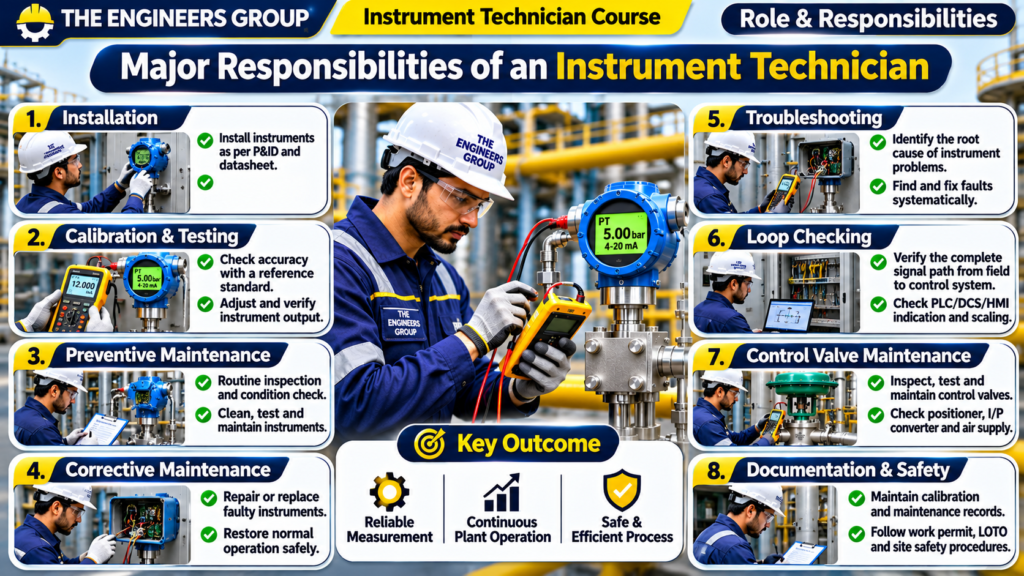
An Instrument Technician performs different responsibilities depending on the industry, plant size and maintenance system.
The following are the major responsibilities.
4.1 Installation and Maintenance of Instruments
The technician installs, inspects and maintains different types of industrial instruments.
Common instruments include:
- Pressure Transmitters
- Differential Pressure Transmitters
- Temperature Transmitters
- RTDs
- Thermocouples
- Magnetic Flow Meters
- Ultrasonic Flow Meters
- Radar Level Transmitters
- Guided Wave Radar Level Transmitters
- Pressure Gauges
- Temperature Gauges
- Level Switches
- Pressure Switches
- Control Valves
The technician must verify the instrument tag number, range, installation location, mounting arrangement and process connections.
4.2 Instrument Calibration
Calibration is one of the most important responsibilities of an Instrument Technician.
Calibration involves comparing an instrument’s indication or output with a suitable reference standard under specified conditions.
Common calibration activities include:
- Pressure Transmitter Calibration
- DP Transmitter Calibration
- Temperature Transmitter Calibration
- Pressure Gauge Calibration
- Temperature Indicator Calibration
- 4–20 mA Loop Calibration
Practical Example:
A pressure transmitter has the following range:
LRV = 0 bar
URV = 10 bar
Output = 4–20 mA
Expected output at 5 bar:
Output = 4 + [(5 − 0) / (10 − 0)] × 16
Output = 12 mA
The technician checks whether the transmitter produces approximately 12 mA at 5 bar, considering the specified tolerance and test conditions.
If the reading is outside the acceptable tolerance, further investigation or adjustment may be required according to the approved calibration procedure.
4.3 Preventive Maintenance
Preventive maintenance means performing scheduled maintenance activities to reduce the possibility of unexpected equipment failure.
Typical activities include:
- Visual inspection of instruments.
- Checking instrument mounting.
- Inspecting impulse lines and process connections.
- Checking electrical connections.
- Inspecting cable glands and junction boxes.
- Checking instrument air supply.
- Inspecting control valve accessories.
- Checking instrument enclosures for moisture or corrosion.
- Performing scheduled calibration checks.
Preventive maintenance improves instrument reliability and helps reduce unexpected plant shutdowns.
4.4 Corrective Maintenance
Corrective maintenance is performed after an instrument fault or abnormal condition has been identified.
Examples:
- Replacing a faulty pressure transmitter.
- Repairing damaged instrument wiring.
- Replacing a defective temperature sensor.
- Correcting an impulse line blockage.
- Repairing a faulty instrument air connection.
- Replacing damaged control valve accessories.
The technician must identify the actual cause of failure before carrying out corrective work.
4.5 Instrument Troubleshooting
Troubleshooting means identifying and diagnosing faults in instrumentation systems.
Common instrument problems include:
- No output signal.
- Incorrect measurement.
- Fluctuating readings.
- Slow instrument response.
- Incorrect 4–20 mA signal.
- Communication failure.
- Sensor failure.
- Power supply problems.
- Blocked impulse lines.
- Control valve not responding.
Practical Example:
A pressure transmitter is showing 0 mA at the control room.
The technician may investigate:
- Check the instrument power supply.
- Inspect the loop wiring.
- Check terminal connections.
- Inspect the transmitter condition.
- Verify the loop resistance and circuit continuity as appropriate.
- Test the transmitter using suitable equipment.
- Check the input channel and control system configuration.
All electrical testing must follow approved isolation and safety procedures.
4.6 Loop Checking
Loop checking verifies the complete measurement signal path from the field instrument to the control system.
A typical 4–20 mA loop may include:
Field Transmitter → Junction Box → Marshalling Cabinet → PLC/DCS Analog Input → HMI Display.
The technician verifies:
- Correct instrument tag.
- Correct wiring and termination.
- Correct signal polarity.
- Signal response at different test points.
- Correct PLC/DCS input.
- Correct engineering units and scaling.
- Correct indication on the HMI.
Loop checking is particularly important during commissioning and after certain maintenance activities.
4.7 Control Valve Maintenance
Control valves regulate process flow, pressure, temperature or level.
Instrument Technicians may inspect and maintain:
- Pneumatic Control Valves
- Electric Control Valves
- Positioners
- I/P Converters
- Solenoid Valves
- Air Filter Regulators
- Valve Accessories
Common maintenance activities include:
- Checking instrument air supply.
- Inspecting air tubing.
- Checking positioner feedback.
- Performing valve stroke tests.
- Checking valve response.
- Inspecting accessories for leakage or damage.
Control valve work must follow the approved process isolation and operating procedures.
5. Instrument Installation and Commissioning
Instrument installation and commissioning are important activities during plant construction, modification and shutdown projects.
An Instrument Technician may be responsible for:
- Verifying the instrument tag number.
- Checking the approved instrument datasheet.
- Inspecting the installation location.
- Checking mounting arrangements.
- Verifying process connections.
- Checking cable routing and termination.
- Confirming instrument power supply.
- Performing calibration and functional checks.
- Supporting loop checking.
- Recording test results.
Example:
During installation of a pressure transmitter, the technician verifies the mounting location, process tapping connection, manifold arrangement, impulse line routing, electrical termination and instrument range.
After installation, the instrument is checked and tested according to the approved commissioning procedure.
6. Instrument Calibration and Testing
Instrument Technicians use specialized calibration equipment to verify instrument performance.
Common calibration equipment includes:
- Pressure Calibrator
- Digital Pressure Gauge
- Handheld Loop Calibrator
- Multifunction Calibrator
- RTD Simulator
- Thermocouple Simulator
- Temperature Dry Block Calibrator
- Multimeter
- HART Communicator
The technician should verify the calibration status and suitability of reference equipment before using it.
Example: Pressure Transmitter Calibration
For a transmitter with a 0–10 bar range and 4–20 mA output:
| Test Point | Applied Pressure | Expected Output |
|---|---|---|
| 0% | 0 bar | 4 mA |
| 25% | 2.5 bar | 8 mA |
| 50% | 5 bar | 12 mA |
| 75% | 7.5 bar | 16 mA |
| 100% | 10 bar | 20 mA |
The technician records the as-found readings before adjustment and as-left readings after any authorized adjustment and verification.
MASTER INDUSTRIAL
INSTRUMENTATION
Build your technical knowledge with our Instrument Technician E-book – English Edition.
Instrument Technician E-book (English Edition)
Learn essential industrial instrumentation concepts, measurement systems, calibration and troubleshooting in one practical guide.
WHAT YOU WILL LEARN:
- Fundamentals of Industrial Instrumentation
- Pressure, Temperature, Flow and Level Measurement
- Sensors, Transmitters and Control Valves
- Instrument Calibration and Troubleshooting
- PLC, SCADA and Industrial Control Systems
- Essential Instrumentation Interview Preparation
SPECIAL OFFER PRICE
Digital eBook – English Edition
Secure online payment • Digital delivery via email
No physical book will be delivered.
Ideal For:
ITI & Diploma Students | B.Tech Graduates | Instrument Technicians | Junior Engineers
Learn • Practice • Improve Your Engineering Skills
THE ENGINEERS GROUP
7. Preventive and Corrective Maintenance
Maintenance activities are generally divided into different categories.
Preventive Maintenance
Maintenance performed at planned intervals to reduce the probability of failure.
Examples:
- Scheduled instrument inspection.
- Periodic calibration.
- Cleaning instrument connections.
- Checking wiring and terminals.
- Checking instrument air supply.
Corrective Maintenance
Maintenance performed to correct an identified fault.
Examples:
- Replacing a failed transmitter.
- Repairing damaged cables.
- Correcting a blocked sensing line.
- Replacing a faulty sensor.
Predictive Maintenance
Maintenance activities based on equipment condition, performance data or trends to identify possible failures before they occur.
Examples:
- Monitoring instrument drift.
- Reviewing recurring fault history.
- Monitoring abnormal measurement trends.
- Identifying repeated control valve performance issues.
8. PLC, DCS, SCADA and Control System Monitoring
Modern industrial plants use automation systems to monitor and control process operations.
Instrument Technicians need a working understanding of these systems.
PLC – Programmable Logic Controller
A PLC receives input signals from field instruments and executes programmed logic to control industrial equipment.
Examples:
- Motor Start/Stop
- Pump Control
- Conveyor Control
- Interlocking Systems
DCS – Distributed Control System
A DCS is used for integrated process monitoring and control in large industrial plants.
Examples:
- Temperature Control
- Pressure Control
- Flow Control
- Level Control
- Process Interlocks
SCADA – Supervisory Control and Data Acquisition
SCADA systems provide supervisory monitoring, data acquisition and control functions.
An Instrument Technician may support signal testing, instrument troubleshooting and communication checks involving these systems.
Important: The technician must understand the difference between a field instrument problem, wiring problem, input-channel problem and control-system configuration problem.
9. Control Valve Inspection and Maintenance
Control valves are final control elements used to regulate process variables.
Instrument Technicians may perform the following activities:
- Inspect valve positioners.
- Check instrument air pressure.
- Inspect I/P converters.
- Check solenoid valve operation.
- Verify position feedback.
- Support valve stroke testing.
- Identify air leakage.
- Check abnormal valve movement.
- Support actuator and accessory maintenance.
Practical Example:
A control valve receives a 50% command from the control system, but the actual valve position remains at 20%.
The technician may check the instrument air supply, positioner settings, feedback mechanism, actuator condition and mechanical movement.
The investigation should follow the approved maintenance procedure and process safety requirements.
10. Instrument Loop Checking
Loop checking confirms that the field instrument and its associated control system work together correctly.
A typical loop-checking procedure includes:
- Verify the instrument tag number.
- Check the approved loop diagram.
- Verify field wiring.
- Check terminal connections.
- Inject or simulate suitable test signals.
- Verify PLC/DCS input values.
- Check HMI indication and scaling.
- Verify alarm or interlock functionality where included in the approved test scope.
- Record the results.
- Obtain the required inspection and commissioning approval.
Example:
A level transmitter with a 0–100% measuring range and 4–20 mA output is checked at 0%, 25%, 50%, 75% and 100%.
The control room operator verifies the corresponding HMI values during the test.
11. Industrial Safety and Work Permit
Safety is one of the most important responsibilities of an Instrument Technician.
Instrumentation work may involve pressurized pipelines, hazardous gases, electrical systems, hot surfaces and chemical processes.
Before starting any maintenance activity, technicians must follow the plant’s safety management system.
Important safety practices include:
- Obtain the required work permit.
- Follow Lockout/Tagout (LOTO) procedures.
- Confirm equipment isolation.
- Depressurize process connections where required.
- Verify zero-energy conditions.
- Use appropriate Personal Protective Equipment (PPE).
- Follow gas testing requirements where applicable.
- Use approved tools and test equipment.
- Follow confined-space entry procedures when applicable.
- Follow hazardous-area requirements.
- Restore the system only after required checks and authorization.
Important Safety Note:
Never loosen a process connection or remove an instrument from a pressurized line without proper authorization, isolation and verification.
Always follow site-specific procedures and manufacturer’s instructions.
12. Instrument Drawings and Documentation
Instrument Technicians must understand technical drawings and maintain accurate maintenance records.
Common instrumentation documents include:
P&ID – Piping and Instrumentation Diagram
Shows process equipment, pipelines, instruments, control valves and process connections.
Instrument Loop Diagram
Shows the signal path between the field instrument and the control system.
Instrument Hook-up Drawing
Shows mechanical and installation details of instruments.
Instrument Datasheet
Contains technical specifications such as measuring range, output, accuracy, process connection and operating conditions.
Cable Schedule
Provides cable identification, cable type and routing information.
Calibration Report
Records calibration test results, reference equipment and as-found/as-left information.
Maintenance Report
Records the fault, inspection findings, maintenance activities and final equipment condition.
Accurate documentation is essential for maintenance history, traceability and future troubleshooting.
13. Tools and Equipment Used by Instrument Technicians
Instrument Technicians use different tools depending on the work activity.
| Tool / Equipment | Main Application |
|---|---|
| Digital Multimeter | Electrical measurements |
| Loop Calibrator | 4–20 mA signal testing |
| Pressure Calibrator | Pressure instrument testing |
| HART Communicator | Configuration and diagnostics of supported HART instruments |
| RTD Simulator | RTD signal simulation |
| Thermocouple Simulator | Thermocouple signal simulation |
| Temperature Dry Block | Temperature calibration |
| Digital Pressure Gauge | Reference pressure measurement |
| Insulation Resistance Tester | Insulation testing where suitable |
| Hand Tools | Installation and maintenance |
| Laptop with Approved Software | Configuration and diagnostics of supported systems |
Technicians must use equipment suitable for the measurement task and hazardous-area classification.
14. Daily Activities of an Instrument Technician
The daily routine depends on the plant’s maintenance schedule, process requirements and shift pattern.
Typical activities include:
Beginning of Shift
- Attend shift handover.
- Review pending maintenance jobs.
- Check work permits.
- Understand process and equipment priorities.
- Coordinate with the control room.
During the Shift
- Perform scheduled instrument inspections.
- Attend breakdown maintenance calls.
- Perform calibration activities.
- Troubleshoot field instruments.
- Support control valve maintenance.
- Assist in loop checking and commissioning.
- Update maintenance records.
End of Shift
- Record completed work.
- Report pending jobs.
- Communicate equipment status.
- Hand over unresolved issues.
- Ensure tools and work areas are left in a safe condition.
15. Skills Required to Become an Instrument Technician
An Instrument Technician needs both theoretical knowledge and practical skills.
Technical Skills
- Industrial Instrumentation Fundamentals
- Pressure Measurement
- Temperature Measurement
- Flow Measurement
- Level Measurement
- Instrument Calibration
- 4–20 mA Signal Fundamentals
- Control Valve Fundamentals
- PLC and DCS Basics
- Instrument Troubleshooting
- Loop Checking
- Reading P&ID and Loop Diagrams
Practical Skills
- Using a Digital Multimeter.
- Using a Loop Calibrator.
- Using a Pressure Calibrator.
- Performing basic instrument calibration.
- Checking electrical terminations.
- Identifying faulty instruments.
- Reading instrument datasheets.
- Preparing maintenance reports.
Professional Skills
- Communication
- Teamwork
- Problem Solving
- Safety Awareness
- Technical Documentation
- Time Management
- Attention to Detail
16. Industries Where Instrument Technicians Work
Instrument Technicians are employed in many industries where measurement and process control systems are used.
Major industries include:
- Oil and Gas Industry
- Petrochemical Industry
- Chemical Processing Plants
- Power Generation Plants
- Pharmaceutical Industry
- Cement Industry
- Steel Manufacturing
- Food and Beverage Industry
- Water Treatment Plants
- Paper and Pulp Industry
- Fertilizer Plants
- Refineries
Each industry has different process requirements, instruments and safety procedures.
17. Common Challenges Faced by Instrument Technicians
Instrument Technicians may face several technical and operational challenges.
| Challenge | Possible Solution |
|---|---|
| Unstable transmitter output | Check process conditions, wiring, power supply and grounding |
| Incorrect pressure reading | Verify calibration, impulse lines and process connection |
| RTD measurement error | Check sensor resistance, wiring and configuration |
| Flow measurement problem | Inspect sensor installation, process conditions and transmitter configuration |
| Control valve hunting | Check tuning, positioner, actuator and process behavior |
| Communication failure | Check wiring, device compatibility and communication configuration |
| Repeated instrument failure | Review failure history and investigate the root cause |
Troubleshooting should be systematic and based on measurements, drawings, equipment history and approved procedures.
18. Importance of Instrument Technicians in Industrial Plants
Instrument Technicians play an important role in maintaining reliable industrial operations.
Their contribution includes:
1. Measurement Accuracy
Proper instrument maintenance helps maintain reliable process measurements.
2. Process Reliability
Healthy instruments support stable process monitoring and control.
3. Equipment Protection
Correct instrument signals help control systems respond to abnormal process conditions.
4. Production Continuity
Effective maintenance helps reduce instrument-related downtime.
5. Process Safety
Reliable instrumentation supports alarms, monitoring and protective functions.
6. Maintenance Efficiency
Good troubleshooting and documentation help maintenance teams identify and resolve recurring faults.
19. Instrument Technician Interview Questions and Answers
Q1. What is the main role of an Instrument Technician?
Answer: The main role is to install, inspect, calibrate, test, maintain and troubleshoot industrial measurement and control instruments.
Q2. What are the major responsibilities of an Instrument Technician?
Answer: Major responsibilities include instrument installation, calibration, preventive maintenance, corrective maintenance, troubleshooting, loop checking, commissioning support and documentation.
Q3. What is instrument calibration?
Answer: Calibration is the process of comparing an instrument’s indication or output with a suitable reference standard under specified conditions.
Q4. What is the difference between preventive and corrective maintenance?
Answer: Preventive maintenance is performed at planned intervals to reduce the probability of failure, whereas corrective maintenance is performed to correct an identified fault.
Q5. What is a 4–20 mA signal?
Answer: It is a common industrial analog current signal used to transmit measurement information from field instruments to control systems.
Q6. What is loop checking?
Answer: Loop checking verifies the complete signal path from a field instrument through associated wiring and control system input to the operator display.
Q7. What is a P&ID?
Answer: P&ID stands for Piping and Instrumentation Diagram. It shows process equipment, pipelines, instruments and control arrangements.
Q8. What is a loop diagram?
Answer: A loop diagram shows the wiring and signal connections associated with an instrument loop.
Q9. What is a HART Communicator?
Answer: It is a configuration and diagnostic tool used with supported HART-compatible field devices.
Q10. What is a pressure transmitter?
Answer: A pressure transmitter measures process pressure and converts it into a standardized output signal, commonly 4–20 mA.
Q11. What is the function of a control valve?
Answer: A control valve regulates process flow or another process variable according to a control signal.
Q12. What is LOTO?
Answer: LOTO stands for Lockout/Tagout. It is a safety procedure used to isolate energy sources and prevent unexpected equipment energization during maintenance.
Q13. What is preventive maintenance?
Answer: Preventive maintenance is planned maintenance performed to reduce the likelihood of equipment failure.
Q14. Why is documentation important in instrumentation maintenance?
Answer: Documentation provides maintenance history, calibration records, traceability and information required for future troubleshooting.
Q15. What safety precautions should an Instrument Technician follow?
Answer: The technician should follow approved work permits, isolation and LOTO procedures, PPE requirements, gas testing and site-specific safety instructions.
⚙️ 100 INSTRUMENTATION INTERVIEW Q&A
Prepare for your Instrument Technician and Instrumentation Engineer interviews with 100 important technical questions and answers.
📥 DOWNLOAD 100 INTERVIEW Q&A PDFFREE STUDY MATERIAL | THE ENGINEERS GROUP
20. Multiple Choice Questions (MCQs)
Q1. What is the main responsibility of an Instrument Technician?
A. Civil construction
B. Instrument installation and maintenance
C. Building design
D. Material transportation
Correct Answer: B. Instrument installation and maintenance
Q2. Which instrument is used to measure pipeline pressure?
A. RTD
B. Pressure Transmitter
C. Flow Switch
D. Thermocouple
Correct Answer: B. Pressure Transmitter
Q3. Which signal is commonly used by industrial analog transmitters?
A. 0–1 V only
B. 4–20 mA
C. 220 V AC
D. 100 A
Correct Answer: B. 4–20 mA
Q4. What is the full form of PLC?
A. Process Line Control
B. Programmable Logic Controller
C. Pressure Level Controller
D. Power Load Control
Correct Answer: B. Programmable Logic Controller
Q5. Which tool is commonly used to measure voltage and resistance?
A. Pressure Calibrator
B. Digital Multimeter
C. HART Communicator
D. Temperature Dry Block
Correct Answer: B. Digital Multimeter
Q6. What is the purpose of instrument calibration?
A. Increase pipeline pressure
B. Compare instrument performance with a reference standard
C. Increase motor speed
D. Reduce cable length
Correct Answer: B. Compare instrument performance with a reference standard
Q7. What does LOTO stand for?
A. Level Output Test Operation
B. Lockout/Tagout
C. Line Operation Testing Output
D. Local Operating Temperature Output
Correct Answer: B. Lockout/Tagout
Q8. Which drawing shows process pipelines and instrument symbols?
A. Electrical Layout
B. P&ID
C. Civil Drawing
D. Foundation Drawing
Correct Answer: B. P&ID
Q9. Which device is used for digital configuration of supported HART instruments?
A. HART Communicator
B. Pressure Gauge
C. Megger
D. Tachometer
Correct Answer: A. HART Communicator
Q10. What is preventive maintenance?
A. Repair after failure only
B. Planned maintenance to reduce the possibility of failure
C. Equipment disposal
D. Emergency shutdown
Correct Answer: B. Planned maintenance to reduce the possibility of failure
Q11. Which instrument measures temperature using resistance change?
A. RTD
B. Pressure Gauge
C. Orifice Plate
D. Radar Level Transmitter
Correct Answer: A. RTD
Q12. Which instrument is used to control process flow?
A. Pressure Gauge
B. Control Valve
C. Junction Box
D. Thermowell
Correct Answer: B. Control Valve
Q13. What is the main purpose of loop checking?
A. Check mechanical alignment only
B. Verify the complete instrument signal path
C. Measure motor insulation only
D. Check pipeline thickness
Correct Answer: B. Verify the complete instrument signal path
Q14. Which equipment is commonly used for pressure transmitter testing?
A. Pressure Calibrator
B. Welding Machine
C. Tachometer
D. Clamp Meter only
Correct Answer: A. Pressure Calibrator
Q15. Which document provides instrument technical specifications?
A. Instrument Datasheet
B. Attendance Sheet
C. Purchase Invoice only
D. Shift Roster
Correct Answer: A. Instrument Datasheet
21. Chapter Summary
An Instrument Technician is an important member of an industrial maintenance and automation team.
The main responsibilities include:
- Installation of industrial instruments.
- Calibration and testing.
- Preventive and corrective maintenance.
- Instrument troubleshooting.
- Control valve inspection and maintenance.
- Loop checking and commissioning support.
- PLC, DCS and SCADA-related instrumentation support.
- Reading P&IDs and instrument drawings.
- Following industrial safety procedures.
- Maintaining technical documentation.
To become a skilled Instrument Technician, a person should develop strong theoretical knowledge, practical experience, troubleshooting ability and safety awareness.
Remember: A good Instrument Technician does not simply replace faulty instruments. A skilled technician identifies the root cause, verifies the measurement system and restores equipment operation safely.
Learn More with THE ENGINEERS GROUP
THE ENGINEERS GROUP provides engineering learning resources for ITI students, Diploma holders, B.Tech students, Instrument Technicians and Maintenance Engineers.
Learn industrial instrumentation concepts, practical applications, calibration procedures and troubleshooting techniques.
Learn • Practice • Improve Your Engineering Skills
THE ENGINEERS GROUP
CONNECT WITH THE ENGINEERS GROUP
Learn. Practice. Improve. Grow.
📘 EXPLORE OUR EBOOK 💬 CONTACT US ON WHATSAPP ▶️ SUBSCRIBE ON YOUTUBE FOLLOW US ON FACEBOOKTHE ENGINEERS GROUP
Free Engineering Education for Everyone