What Is Electricity? Complete Guide to Electrical Fundamentals
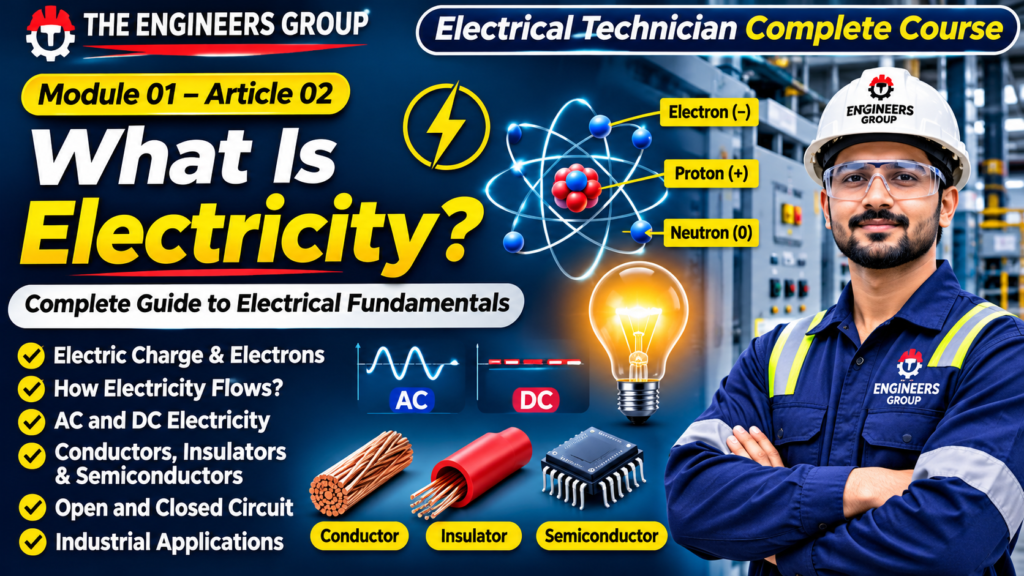
What Is Electricity?
Electricity is one of the most important forms of energy used in modern life and industrial applications. From lighting systems and household appliances to industrial motors, transformers, electrical panels, and automation systems, electricity plays an essential role in almost every sector.
Understanding electricity is the first step for anyone who wants to become an Electrical Technician or Electrical Engineer.
But what exactly is electricity? How does electric current flow? What are electrons, electric charges, conductors, and insulators? How is electricity used in industrial electrical systems?
In this article, we will explain the basic concepts of electricity, its types, electric charge, electron flow, conventional current, electrical conductors, insulators, and practical applications.
This guide is specially designed for ITI Electrical students, Diploma Engineers, B.Tech students, beginners, and working electrical technicians.
Table of Contents
- What Is Electricity?
- What Is Electric Charge?
- What Are Electrons?
- How Is Electricity Produced?
- How Does Electricity Flow?
- Electron Flow vs Conventional Current
- Types of Electricity
- What Are Conductors?
- What Are Insulators?
- What Are Semiconductors?
- Open Circuit and Closed Circuit
- Basic Electrical Terms
- Applications of Electricity in Industries
- Practical Examples of Electricity
- Safety Precautions While Working with Electricity
- Frequently Asked Questions (FAQs)
- Electricity Interview Questions and Answers
1. What Is Electricity?
Electricity is a form of energy associated with the presence and movement of electric charges.
In electrical circuits, electricity is commonly used to transfer energy from a power source to an electrical load.
Electricity makes it possible to operate:
- Electric Motors
- Transformers
- Generators
- Lighting Systems
- Pumps and Compressors
- Industrial Control Panels
- PLC and Automation Systems
- Computers and Electronic Equipment
For example, when an electric motor is connected to a suitable electrical supply, electric current flows through its windings and produces a magnetic field that helps generate mechanical rotation.
Electricity is the foundation of electrical engineering, industrial automation, power generation, and electrical maintenance.
Simple Definition
Electricity is the phenomenon associated with electric charges and their effects, including electric current, voltage, and electrical energy.
2. What Is Electric Charge?
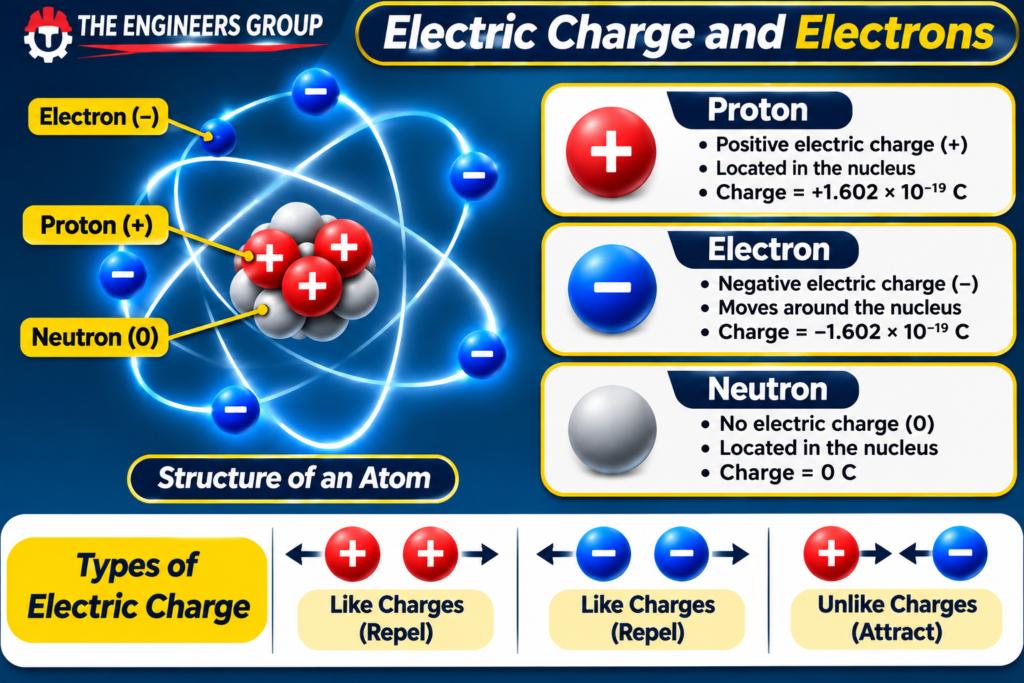
Electric charge is a fundamental property of matter responsible for electrical interactions.
There are two types of electric charges:
- Positive Charge
- Negative Charge
Positive Charge
A proton carries a positive electric charge.
Negative Charge
An electron carries a negative electric charge.
Neutral Charge
A neutron has no net electric charge.
An atom normally contains protons and neutrons in its nucleus, while electrons occupy regions around the nucleus.
When an object gains or loses electrons, it can become electrically charged.
Unit of Electric Charge
The SI unit of electric charge is the Coulomb (C).
The magnitude of the charge of one electron is approximately:
1.602 × 10⁻¹⁹ Coulomb
This is an important fundamental value in electrical physics.
💬 NEED GUIDANCE
Contact THE ENGINEERS GROUP for eBook details, course information and learning support.
MESSAGE US ON WHATSAPP3. What Are Electrons?
Electrons are negatively charged subatomic particles found in atoms.
Electrons are especially important in electrical engineering because the movement of charge carriers through conductors produces electric current.
In metallic conductors such as copper and aluminium, electric current is mainly carried by free electrons.
How Do Electrons Move?
When a suitable voltage is applied across a conductor, an electric field is established inside the conductor.
Free electrons respond to this electric field and acquire a net drift motion.
This movement of charge produces electric current.
For example, when a copper wire connects a battery to a lamp, the electrical circuit allows current to flow and the lamp can produce light.
4. How Is Electricity Produced?
Electricity can be produced by converting different forms of energy into electrical energy.
There are several methods of electricity generation.
4.1 Electromagnetic Induction
Electromagnetic induction is one of the most important principles used in electrical power generation.
When the magnetic flux linking a conductor or coil changes, an electromotive force (EMF) is induced.
This principle is used in electrical generators and alternators.
4.2 Solar Energy
Solar panels use photovoltaic cells to convert sunlight directly into electrical energy.
Solar power systems are commonly used in residential, commercial, and industrial applications.
4.3 Chemical Energy
Batteries convert chemical energy into electrical energy through electrochemical reactions.
Examples include:
- Lead-Acid Batteries
- Lithium-Ion Batteries
- Alkaline Batteries
4.4 Wind Energy
Wind turbines convert the kinetic energy of moving air into mechanical energy, which drives a generator to produce electricity.
4.5 Hydroelectric Energy
Hydroelectric power plants use flowing or falling water to rotate turbines connected to electrical generators.
4.6 Thermal Energy
Thermal power plants use heat energy to produce steam or drive turbines, which operate generators to generate electricity.
5. How Does Electricity Flow?
Electric current flows through a suitable conducting path when a potential difference is applied and the circuit provides a complete path.
The main requirements for a basic electrical circuit are:
- Power Source
- Conducting Wires
- Electrical Load
- Complete Circuit Path
Example: Battery and Bulb Circuit
Consider a simple circuit containing a battery, connecting wires, a switch, and a bulb.
Step 1: The battery provides an electrical potential difference.
Step 2: The switch is closed to complete the circuit.
Step 3: An electric field is established throughout the conducting path.
Step 4: Electric current flows through the circuit.
Step 5: The bulb converts electrical energy into light and heat.
When the switch is opened, the conducting path is interrupted and current stops flowing in the normal circuit.
6. Electron Flow vs Conventional Current
There are two commonly used ways to describe the direction of electric current.
6.1 Electron Flow
Electron flow describes the movement of negatively charged electrons through a conductor.
In a metallic conductor, the net electron drift direction is from the negative terminal towards the positive terminal of the source.
6.2 Conventional Current
Conventional current is defined as the direction in which positive charge would move.
In a typical DC circuit, conventional current flows from the positive terminal towards the negative terminal through the external circuit.
Difference Between Electron Flow and Conventional Current
| Electron Flow | Conventional Current |
|---|---|
| Movement of electrons | Defined direction of positive charge flow |
| Negative to positive terminal in an external DC circuit | Positive to negative terminal in an external DC circuit |
| Based on electron movement in metallic conductors | Standard direction used in circuit analysis |
| Electrons carry negative charge | Current direction is defined using positive charge convention |
Important: Conventional current is the standard direction used in electrical circuit diagrams, engineering calculations, and most electrical textbooks.
7. Types of Electricity
In electrical engineering, electricity is commonly studied through two main types of electric current:
- Direct Current (DC)
- Alternating Current (AC)
7.1 Direct Current (DC)
Direct Current flows in one direction through a circuit.
In steady DC, the polarity remains constant.
Common DC applications include:
- Battery Systems
- 24 V DC Control Circuits
- PLC Control Systems
- Electronic Equipment
- Solar DC Systems
- DC Power Supplies
Example:
A 24 V DC power supply is commonly used to supply industrial PLCs, sensors, and control circuits.
7.2 Alternating Current (AC)
Alternating Current periodically changes its magnitude and direction.
AC supply is widely used in electrical power generation, transmission, distribution, and industrial applications.
Common AC applications include:
- Three-Phase Induction Motors
- Industrial Pumps
- Compressors
- Transformers
- Residential Power Supply
- Industrial Electrical Panels
In India, standard utility supply frequency is 50 Hz.
Difference Between AC and DC
| AC | DC |
|---|---|
| Changes direction periodically | Flows in one direction |
| Has frequency | Steady DC has zero frequency |
| Commonly used in power distribution | Commonly used in batteries and control systems |
| Can be transformed using transformers | Voltage conversion generally uses electronic converters |
| Used in AC motors | Used in DC motors and electronic circuits |
⚡ Electrical Technician eBook
Hinglish Edition
Master Electrical Engineering from Basic to Advanced. Learn important electrical concepts with simple Hindi explanations and English technical terminology.
Special Digital eBook Offer
BUY NOW – GET YOUR EBOOK →No physical book will be delivered.
8. What Are Conductors?
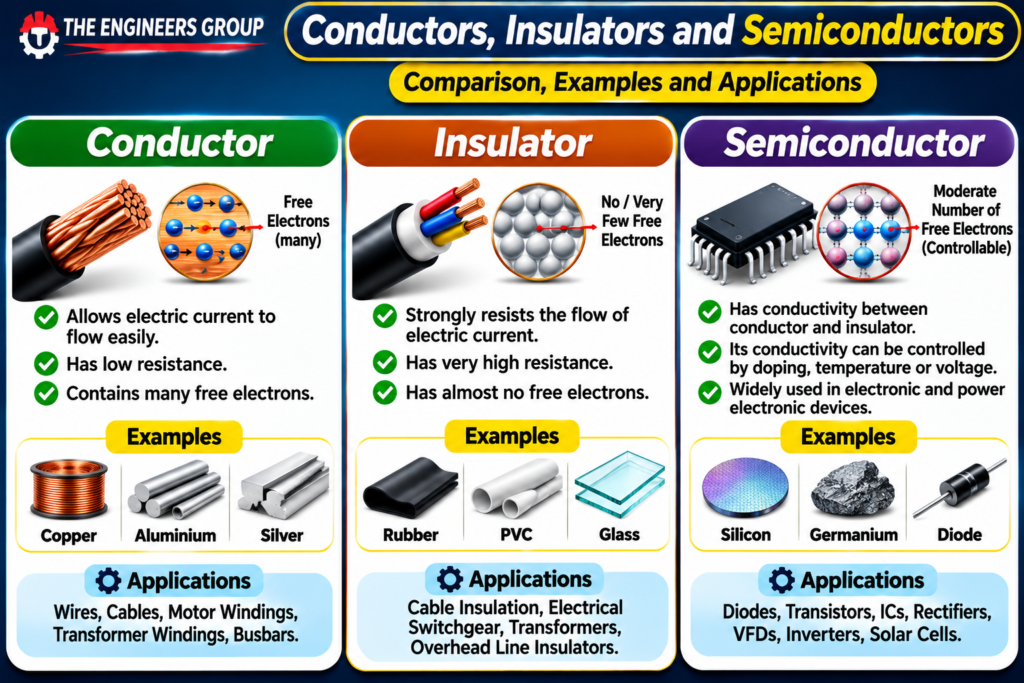
A conductor is a material that allows electric current to flow relatively easily because it contains mobile charge carriers.
Conductors are widely used in electrical wiring, cables, motors, transformers, and electrical equipment.
Common Electrical Conductors
1. Copper
Copper is widely used in electrical cables and wiring because of its high electrical conductivity and good mechanical properties.
2. Aluminium
Aluminium is commonly used in overhead transmission lines and electrical cables because of its low weight and useful conductivity-to-weight ratio.
3. Silver
Silver has very high electrical conductivity, but its cost limits its use in ordinary power wiring.
Applications of Conductors
- Electrical Cables
- Motor Windings
- Transformer Windings
- Busbars
- Earthing Conductors
- Electrical Connections
9. What Are Insulators?
An insulator is a material that strongly resists the flow of electric current.
Insulating materials are used to prevent unwanted current flow and provide electrical separation between conductive parts.
Common Electrical Insulators
- Rubber
- PVC
- Glass
- Porcelain
- Mica
- Dry Air
- Insulating Oil
Applications of Insulators
- Cable Insulation
- Transformer Insulation
- Electrical Switchgear
- Overhead Line Insulators
- Motor Winding Insulation
- Electrical Safety Equipment
Insulation condition is important for preventing leakage current, short circuits, and electrical breakdown.
10. What Are Semiconductors?
A semiconductor is a material whose electrical conductivity lies between that of a conductor and an insulator under specified conditions.
Its conductivity can be controlled by doping, temperature, electric fields, and other physical effects.
Common Semiconductor Materials
- Silicon
- Germanium
Applications of Semiconductors
- Diodes
- Transistors
- Integrated Circuits
- Rectifiers
- Power Electronic Devices
- VFD Inverter Circuits
- Solar Cells
Semiconductors play an important role in modern electrical and electronic equipment.
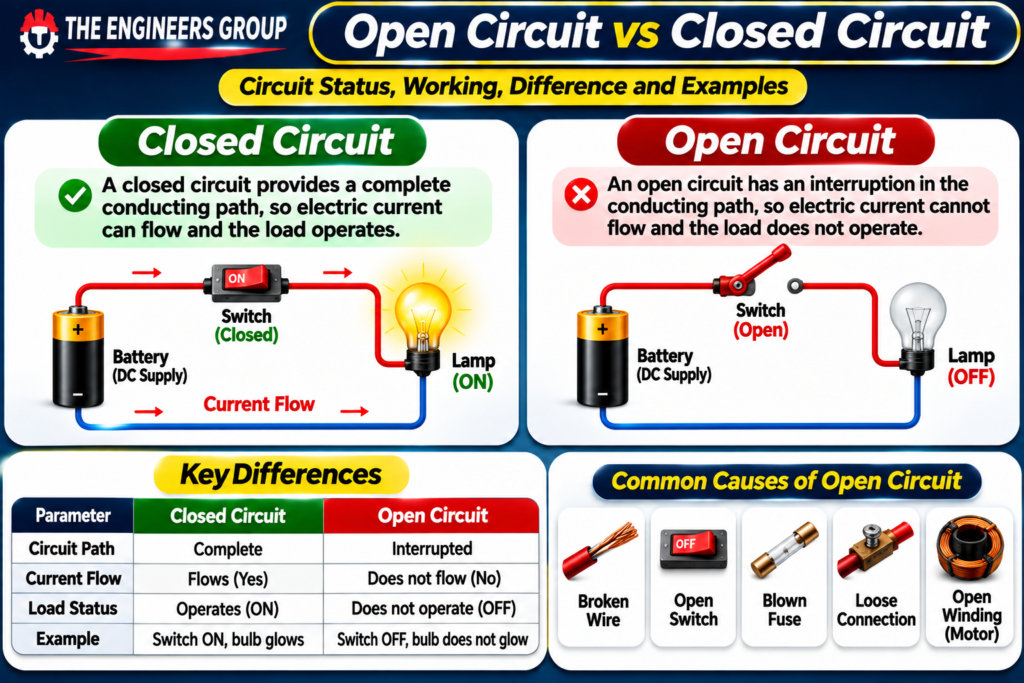
11. Open Circuit and Closed Circuit
An electrical circuit is a conducting path that allows current to flow when suitable electrical conditions are present.
11.1 Closed Circuit
A closed circuit provides a complete conducting path.
When the source provides a suitable voltage and the circuit is functioning correctly, current can flow through the load.
Example:
When a switch is turned ON, the circuit is completed and the lamp can glow.
11.2 Open Circuit
An open circuit contains an interruption in the conducting path.
As a result, normal load current cannot flow.
Common causes include:
- Broken Wire
- Open Switch
- Blown Fuse
- Loose Connection
- Broken Conductor
- Open Motor Winding
Difference Between Open and Closed Circuit
| Open Circuit | Closed Circuit |
|---|---|
| Path is interrupted | Path is complete |
| Normal load current does not flow | Current can flow |
| Load generally does not operate | Load can operate |
| May be caused by broken wiring | Requires a complete conducting path |
12. Basic Electrical Terms
Every electrical technician should understand the following important electrical terms.
Voltage: Electrical potential difference between two points. Unit: Volt (V).
Current: Rate of flow of electric charge. Unit: Ampere (A).
Resistance: Opposition to electric current. Unit: Ohm (Ω).
Power: Rate of electrical energy transfer. Unit: Watt (W).
Energy: Total electrical energy consumed or transferred. Common unit: kWh.
Frequency: Number of complete cycles per second of a periodic signal. Unit: Hertz (Hz).
Circuit: A conducting path through which electric current can flow.
Load: An electrical device that consumes or uses electrical energy.
Source: A device or system that supplies electrical energy to a circuit.
Insulation: Material or system used to electrically separate conductive parts.
These terms form the foundation of electrical engineering.
13. Applications of Electricity in Industries
Electricity is essential for operating modern industrial plants and manufacturing facilities.
13.1 Electric Motors
Electric motors convert electrical energy into mechanical energy.
They are used in pumps, compressors, conveyors, fans, and industrial machines.
13.2 Transformers
Transformers are used to change AC voltage levels in electrical power systems.
They are essential for power transmission, distribution, and industrial electrical supply.
13.3 Industrial Control Panels
Electrical control panels distribute electrical power and control machines through components such as contactors, relays, circuit breakers, and control devices.
13.4 PLC Automation Systems
PLC systems use electrical signals from sensors and switches to control industrial machines and processes.
13.5 VFD Systems
Variable Frequency Drives control the speed of suitable AC motors by changing the supply frequency and voltage.
13.6 Lighting Systems
Industrial lighting systems provide illumination in manufacturing areas, workshops, warehouses, and other facilities.
14. Practical Examples of Electricity
Example 1: Battery and LED
A battery provides DC voltage to an LED through a suitable current-limiting arrangement.
The LED converts electrical energy into light.
Example 2: Industrial Motor
A three-phase AC supply is connected to a motor through an appropriate switching and protection arrangement.
When the motor starts, electrical energy is converted into mechanical rotation.
Example 3: PLC Control Circuit
A 24 V DC power supply provides power to a PLC control system.
A sensor sends an input signal to the PLC, and the PLC processes the input according to its programmed logic.
The PLC then operates an output device, such as an interposing relay or contactor, through a suitable interface.
Example 4: Electrical Heater
An electrical heater converts electrical energy into heat through resistive heating.
These examples show how electricity is used in everyday and industrial applications.
15. Safety Precautions While Working with Electricity
Electricity can be dangerous if electrical equipment is handled incorrectly.
Electrical technicians must follow approved safety procedures before performing electrical work.
Important precautions include:
- Isolate the electrical supply before maintenance.
- Apply Lockout/Tagout (LOTO).
- Verify absence of voltage using a properly rated tester.
- Wear suitable electrical PPE.
- Use appropriately rated insulated tools.
- Maintain proper earthing and bonding.
- Never touch exposed live conductors.
- Follow approved electrical drawings and procedures.
- Maintain safe working distances.
- Only authorized and competent personnel should perform electrical work.
Always follow site-specific safety rules and applicable electrical standards.
⚡ 100 ELECTRICAL INTERVIEW Q&A
Prepare for Electrical Technician and Electrical Engineer interviews with 100 important technical questions and answers.
📥 DOWNLOAD ELECTRICAL PDFFREE STUDY MATERIAL | THE ENGINEERS GROUP
16. Frequently Asked Questions (FAQs)
Q1. What is electricity in simple words?
Electricity is a phenomenon associated with electric charges and their effects. In electrical circuits, it allows energy to be transferred from a source to a load.
Q2. What are the two main types of electric current?
The two main types are Alternating Current (AC) and Direct Current (DC).
Q3. What is the difference between AC and DC electricity?
AC periodically changes direction, while DC flows in one direction with constant polarity under steady-state conditions.
Q4. What is an electron?
An electron is a negatively charged subatomic particle. Its movement in metallic conductors contributes to electric current.
Q5. What is electric charge?
Electric charge is a fundamental property of matter responsible for electrical interactions. It can be positive or negative.
Q6. What is the difference between a conductor and an insulator?
A conductor allows electric current to flow relatively easily, while an insulator strongly resists electric current flow.
Q7. Why is copper used in electrical wiring?
Copper has high electrical conductivity, good mechanical properties, and is suitable for many electrical wiring applications.
Q8. What is conventional current?
Conventional current is the defined direction of positive charge flow. In an external DC circuit, it flows from the positive terminal towards the negative terminal.
Q9. What is the unit of electric charge?
The SI unit of electric charge is the Coulomb (C).
Q10. How is electricity generated?
Electricity can be generated by converting mechanical, chemical, solar, thermal, wind, and other forms of energy into electrical energy.
17. Electricity Interview Questions and Answers
Q1. What is electricity?
Answer: Electricity is a phenomenon associated with electric charges and their effects, including electric current and electrical energy transfer.
Q2. What is the charge of an electron?
Answer: An electron carries a negative charge of approximately 1.602 × 10⁻¹⁹ Coulomb.
Q3. What is the SI unit of electric current?
Answer: Ampere (A).
Q4. What is the SI unit of voltage?
Answer: Volt (V).
Q5. What is the SI unit of resistance?
Answer: Ohm (Ω).
Q6. What is the difference between electron flow and conventional current?
Answer: Electron flow in a metallic conductor is from negative to positive in an external DC circuit, while conventional current is defined from positive to negative.
Q7. What is a conductor?
Answer: A conductor is a material that allows electric current to flow relatively easily.
Q8. What is an insulator?
Answer: An insulator is a material that strongly resists the flow of electric current.
Q9. What is a semiconductor?
Answer: A semiconductor is a material whose conductivity can be controlled through doping and other physical conditions.
Q10. What is an open circuit?
Answer: An open circuit has an interrupted conducting path, so normal load current cannot flow.
Q11. What is a closed circuit?
Answer: A closed circuit provides a complete conducting path through which current can flow when suitable voltage is applied.
Q12. What is the standard AC supply frequency in India?
Answer: The standard utility supply frequency in India is 50 Hz.
Q13. What is electromagnetic induction?
Answer: Electromagnetic induction is the production of an EMF when the magnetic flux linking a conductor or coil changes.
Q14. Which metal is commonly used in electrical wiring?
Answer: Copper is commonly used because of its high electrical conductivity.
Q15. Why is electricity important in industries?
Answer: Electricity operates industrial motors, pumps, compressors, control panels, automation systems, and other essential equipment.
Conclusion
Electricity is the foundation of modern electrical engineering and industrial technology.
Understanding electric charge, electrons, current flow, conductors, insulators, semiconductors, AC, DC, and electrical circuits is essential for every electrical technician.
These basic concepts help learners understand more advanced topics such as electrical wiring, motors, transformers, electrical protection, VFDs, PLC systems, and industrial troubleshooting.
The Electrical Technician Complete Course by THE ENGINEERS GROUP is designed to help students and working professionals develop electrical knowledge step by step, from basic concepts to advanced industrial applications.
Continue learning with our next article and strengthen your electrical engineering fundamentals.
THE ENGINEERS GROUP – Learn Engineering, Build Skills, Grow Your Career.
CONNECT WITH THE ENGINEERS GROUP
Learn. Practice. Improve. Grow.
📘 EXPLORE OUR EBOOK 💬 CONTACT US ON WHATSAPP ▶️ SUBSCRIBE ON YOUTUBE FOLLOW US ON FACEBOOKTHE ENGINEERS GROUP
Free Engineering Education for Everyone